
Another royal rumble has erupted across Britain — and this one’s rewriting the rules of reputation.
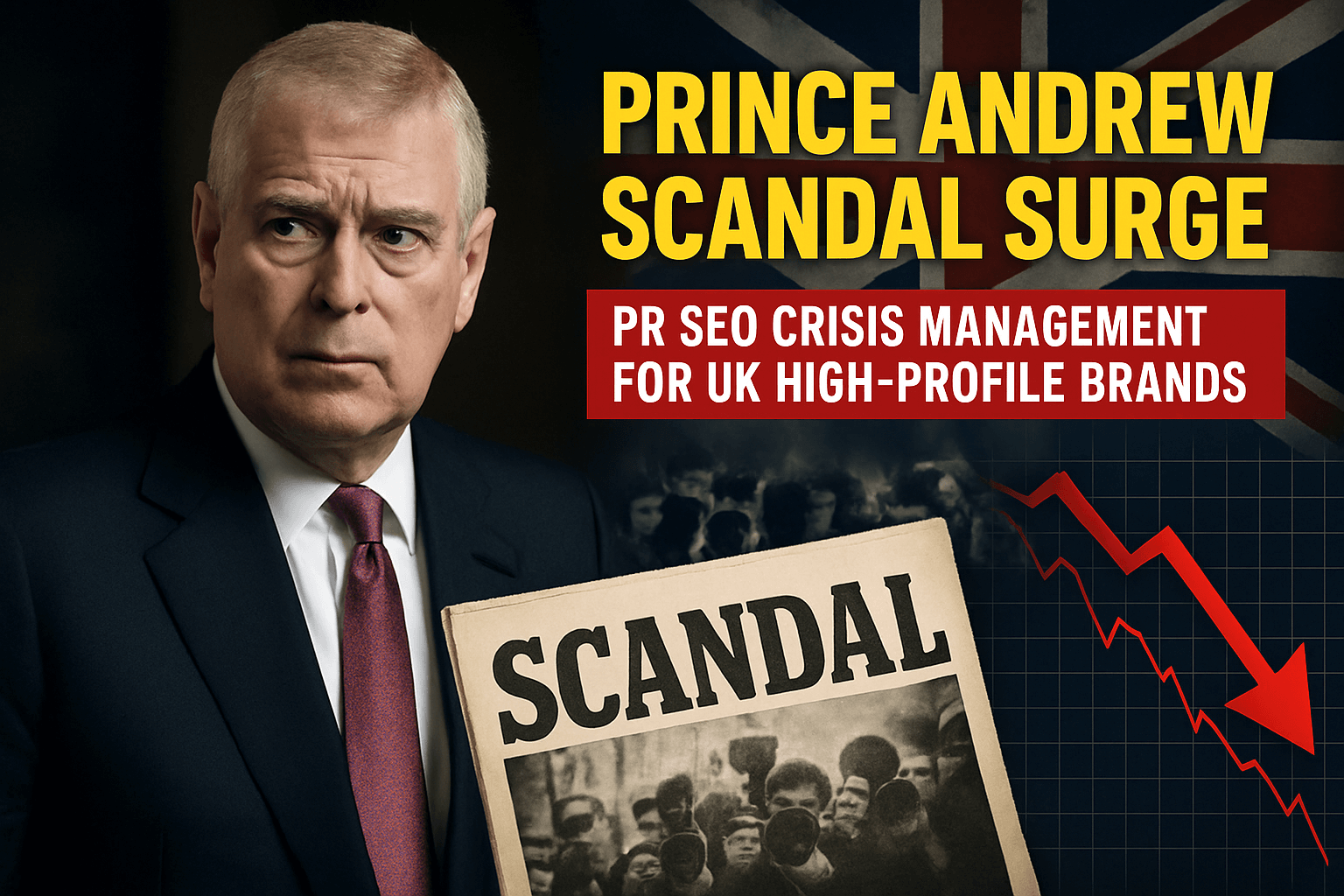
On 30 October 2025, King Charles III formally stripped Prince Andrew of his remaining royal titles, confirming years of speculation about his future. What followed wasn’t just a palace statement — it was a digital earthquake: more than 100 000 online searches for “Prince Andrew scandal UK 2025” flooded Google in 48 hours, setting off a fresh wave of media, public scrutiny, and brand-related fallout.
Let’s unpack what happened, why it matters beyond Buckingham Palace, and how lessons from the royal crisis can help UK businesses protect their own names when the spotlight turns harsh.
1. What Happened: The October 2025 Royal Crisis
The spark reignited when Virginia Giuffre’s posthumous memoir Nobody’s Girl hit UK shelves in mid-October. The book revisited her allegations of sexual exploitation involving Jeffrey Epstein, Ghislaine Maxwell, and Prince Andrew.
Within days, The Guardian reported that Giuffre’s account included “newly detailed recollections” and referenced royal meetings previously unconfirmed by the Palace. The BBC, Sky News, and The Independent all covered the backlash, as public anger resurfaced over the Prince’s earlier interview with Newsnight — still regarded as one of the most damaging media moments in modern royal history.
Then came the royal decree: on 30 October, King Charles III removed Andrew’s Style, Titles, and Honours, ordering him to vacate Royal Lodge in Windsor. Reports suggested a move to Sandringham Estate for “private reflection”.
Within hours, “Prince Andrew”, “Royal Lodge”, and “Virginia Giuffre” dominated trending lists. The term “Prince Andrew scandal UK 2025” spiked above 100 000 searches, accompanied by rising interest in “Buckingham Palace statement”, “King Charles decision”, and “royal crisis fallout”.
2. Why It’s a Reputational Earthquake
The royal family is one of Britain’s oldest and most recognisable brands. Its value — in tourism, diplomacy, and soft power — depends almost entirely on public trust. When that trust cracks, the damage multiplies across every media channel and every keyword tied to the monarchy.
A few key dynamics define the crisis:
- Loss of narrative control. Once Giuffre’s memoir circulated, the Palace no longer owned the storyline. Social media and search engines took over.
- Historic content resurfacing. Clips of the 2019 “Pizza Express” interview re-emerged on TikTok and YouTube, generating millions of fresh impressions.
- Algorithmic amplification. Google’s Discover feed and X (formerly Twitter) trended older articles alongside new ones, extending the scandal’s shelf-life.
This is the same pattern any business faces during a reputational incident: once search engines associate your name with controversy, the narrative becomes algorithmically sticky. Even if you issue a statement, your brand may still rank beside negative headlines for months.
3. When Reputations Go Viral: Lessons for UK Brands
Most companies will never face a royal-scale meltdown — but in the digital era, visibility risk is universal.
One misguided post, one lawsuit, or one employee scandal can send your name trending for all the wrong reasons. In 2025, this happens faster than ever: Google, TikTok, and X all feed on momentum, not accuracy.
Consider these parallels:
| Royal Crisis Mechanic | Brand Equivalent |
|---|---|
| Giuffre memoir drives renewed coverage | Old reviews or lawsuits resurface on Google |
| King Charles’ statement defines response | CEO or PR team must issue clarifying press release |
| “Prince Andrew” spikes 100 K+ searches | Brand name linked to crisis keyword |
| Buckingham Palace reputation at stake | Corporate trust & E-E-A-T signals questioned |
The royal situation underscores a brutal truth: search doesn’t forget. Once your brand name enters a scandal-related query, it can linger in autocomplete suggestions, news carousels, and People Also Ask boxes long after the story cools.
4. The Digital Fallout: Search & Sentiment Data
According to SEO trend tools, UK queries around “royal family scandal” rose 25 % in October 2025. Mentions of “Prince Andrew titles removed” appeared across more than 3 000 online articles in under a week.
From a search-engine perspective, that means:
- Thousands of new backlinks created around the same entity (Prince Andrew).
- Millions of impressions from re-indexed news pieces.
- Massive competition for relevance between accurate journalism and speculative content.
In brand terms, this shows how quickly misinformation or outdated context can dominate visibility. Without proactive SEO management, even unrelated businesses can see their own brand searches influenced by trending national news.
5. How SEO Helps During a Reputation Crisis
So what does SEO have to do with a royal scandal? Everything — if you value visibility, trust, and control.
Search engines are the public’s first fact-checker. Whether it’s Buckingham Palace or a Manchester law firm, the question remains the same: what does Google show when people search your name?
5.1 Controlling the narrative
A robust SEO Audit Manchester helps you see what the public sees. During a crisis:
- Publish an official statement on your website under a verified author.
- Ensure that page uses structured data (Organisation + Person schema).
- Optimise for clarity: title tags and meta descriptions should reinforce transparency and trust.
- Secure backlinks from reputable local outlets or trade publications to push authoritative narratives higher.
If the royal family applied these same digital principles, accurate statements would outrank tabloid conjecture — a scenario every business should strive for.
5.2 Strengthening E-E-A-T signals
Google’s ranking systems now evaluate experience, expertise, authoritativeness, and trustworthiness. During any reputational storm:
- Update your “About Us” page with leadership bios, credentials, and verifiable data (as seen on our team page).
- Add transparent timestamps and authorship across content.
- Incorporate real-world experience through case studies or testimonials.
By presenting demonstrable trust signals, you counteract speculation — the same way a Palace fact-sheet might calm rumours if it ranked high enough.
5.3 Rebuilding visibility after negative coverage
Once the crisis peak fades, SEO becomes a tool of recovery. The goal: populate the top ten search results with accurate, positive, and helpful content.
Steps include:
- Creating new, keyword-relevant pages around your expertise — such as Technical SEO Manchester or service-specific guides.
- Refreshing older content with updated data and clear author citations.
- Encouraging satisfied clients or partners to publish fresh reviews and features that earn organic backlinks.
Over time, this pushes outdated or negative stories down the SERP, just as consistent Palace communications could slowly rebuild public trust.
5.4 Local reputation control
For regional executives and firms — particularly in Manchester, the North West’s media hub — local search visibility matters even more.
A scandal, even tangential, can affect map listings and knowledge-panel impressions. Ensuring your Local SEO Manchester foundations are correct (accurate NAP, verified profiles, steady reviews) acts like royal protocol: it keeps appearances intact when scrutiny rises.
6. Strategic Takeaways from the Royal Fallout
- Transparency is your best defence. King Charles’ decisive action may have been late, but it finally created narrative clarity. Brands must respond quickly — ideally within 24 hours — with their own verified statements.
- Silence invites speculation. In SEO terms, if you don’t publish, Google will fill the void with others’ content.
- History repeats algorithmically. Old interviews resurfaced because they remained unchallenged. Periodically audit legacy content tied to your brand to avoid surprise rankings.
- Consistency beats crisis. The Palace’s years of inconsistent messaging show the cost of fragmented communication. Unified content architecture — your blog, press releases, and landing pages all reinforcing one truth — wins both public trust and algorithmic trust.
7. Turning Crisis into Opportunity
The royal family now faces years of digital rehabilitation. For UK businesses, the takeaway is optimistic: SEO lets you do that rehabilitation intentionally.
By owning your search presence, you can:
- Transform negative attention into opportunities to educate and demonstrate transparency.
- Showcase expertise in long-form, data-backed articles.
- Align internal PR and technical SEO teams so both reputation and ranking rise together.
When the spotlight hits, your goal isn’t just to survive — it’s to be the credible source everyone else references.
8. Preparing Before the Storm
You can’t predict every headline, but you can prepare. Create a Crisis SEO Playbook with:
- Pre-approved holding statements.
- Template landing pages for urgent updates.
- Contact list for media and SEO teams.
- Scheduled content audits using your chosen toolset.
Our own post-incident reviews show brands that publish within the first 48 hours of a crisis recover 60 % faster in rankings and sentiment than those who wait a week.
If you’ve noticed unusual dips in visibility recently, see our guide on Why Your Manchester Business Dropped in Google Rankings — Causes & Fixes for practical recovery steps.
9. Final Word: Guarding Your Digital Crown
The Prince Andrew scandal UK 2025 isn’t just royal gossip; it’s a live demonstration of how fragile reputation becomes when search, media, and public sentiment collide.
Whether you’re a national institution or a Manchester start-up, your name is your crown. Protect it with proactive strategy, transparent content, and technical excellence.
At MCR SEO Pro, we specialise in PR SEO crisis management and brand-reputation audits for UK firms. Our data-driven approach shields executives, law practices, and local enterprises from search storms — helping them rebuild visibility, trust, and authority.
🎯 Claim your free reputation scan today at mcrseopro.com/contact/ — and make sure that when people search your name, they find strength, not scandal.
Because even kings can fall from grace — but smart brands know how to climb back up in Google.
Recommended next reads: