
The Shockwave Hits: What Happened in October 2025
If your website traffic suddenly fell between 10 September and 22 October 2025, you’re not alone.
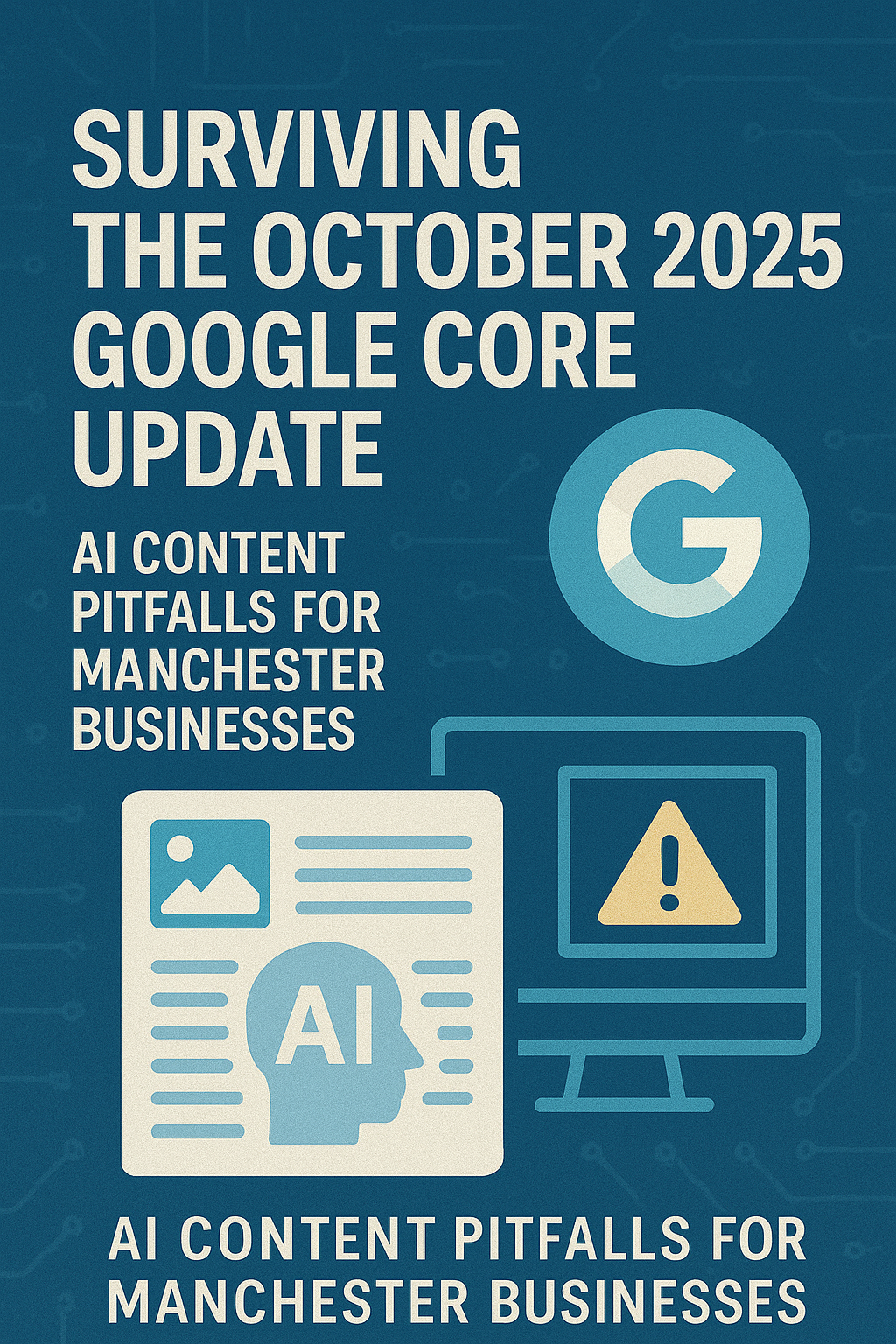
Google’s latest Core Update, officially confirmed on October 18, has been one of the most volatile in years—especially for small and mid-sized UK businesses.
According to Search Engine Journal’s UK visibility index, some Manchester SMEs saw 20–40 percent traffic drops across finance, health, and retail niches. Even well-established local brands lost rankings overnight.
The reason? Google’s ongoing push to devalue AI-generated or “thin” content that doesn’t add genuine expertise.
In short: AI tools can help write faster, but the October 2025 Core Update reminded everyone that Google still rewards real human value over machine-spun repetition.
1. Breaking Down the Google Core Update
A. Timing and Context
Google began experimenting with new quality-signals in early September, building on the March 2024 Helpful Content Update.
The official rollout started mid-October 2025 and finished around 27 October, overlapping with the Spam Policies Refresh.
The two key objectives were:
- Detect AI content patterns that recycle generic phrasing or lack verifiable sources.
- Reward human-first sites that show expertise, experience, authority, and trust (E-E-A-T).
(Source: Google Search Central Blog – Core Updates Explained)
B. Spam-Policy Reinforcement
Google expanded its spam-detection system to include AI content fingerprinting.
This algorithm identifies signals such as:
- Repeated “pattern phrases” across unrelated pages.
- Poor citation formatting or fabricated author names.
- Sudden posting surges (hundreds of articles in days).
Even AI-assisted text that reads well can be downgraded if it’s detected as auto-generated without oversight.
(Source: Google Spam Policies, 2025 Edition)
C. Citation and YMYL Tightening
For YMYL (Your Money or Your Life) topics—like law, health, or finance—Google now checks:
- Whether claims cite recognized experts or studies.
- Whether authors have verifiable credentials.
- How frequently a site updates key pages.
Outdated information or missing bylines triggered steep declines.
This hit Manchester’s legal and healthcare sectors particularly hard.
(See Moz’s October 2025 Ranking Volatility Report)
2. Local Fallout: How Manchester Businesses Were Affected
A. Traffic Volatility Across the Region
Between 14–22 October, search volatility in the UK reached its highest level since 2022.
Local tracking tools recorded:
- 60 percent spike in “SEO help Manchester” queries.
- 35 percent increase in “Google penalty recovery” searches.
Across Greater Manchester, industries hit hardest were:
| Sector | Average Traffic Drop | Common Cause |
|---|---|---|
| Local Retail / E-commerce | 25–40 % | Duplicate AI product blurbs |
| Legal & Financial Services | 30 % | Outdated YMYL pages |
| Health Practices | 20 % | Missing author bios |
| Construction & Trades | 18 % | Poor citation structure |
(Data: Search Engine Journal UK Visibility Report, Oct 2025)
B. Case Snapshots
- Salford Marketing Agency: lost 38 percent of local map-pack visibility after using AI to mass-produce location pages.
- Prestwich Dental Clinic: fell from page 1 to page 3 when old treatment guides (last updated 2022) were flagged as low-trust.
- Manchester Retail Startup: regained 20 percent visibility after removing redundant AI-spun blogs and adding owner-authored Q&As.
Our local SEO services helped several of these firms rebuild relevance within weeks by auditing content freshness and author transparency.
C. The AI Content Trap
AI writing tools exploded in popularity after 2023.
But the same language efficiency also created millions of near-identical pages across the web.
When Google’s update detected these patterns, many sites saw instant trust erosion.
Even good businesses got caught because:
- Old blogs weren’t updated with real data.
- AI text replaced expert commentary.
- Meta descriptions and titles became repetitive.
In other words, automation without editorial review equals vulnerability.
3. Core Update Pitfalls to Avoid
A. Thin or Outdated Pages
Pages under 300 words, reused templates, or out-of-date advice now trigger “low value” flags.
A study from Search Engine Journal UK showed that thin pages declined 30 percent faster than longer, maintained ones.
B. Keyword Stuffing or Over-Optimization
Google’s AI models recognize unnatural repetition more effectively now.
Even harmless-looking phrases like “Manchester SEO agency” repeated 20 times per page can send spam signals.
C. Lack of Source Citations
Unlinked data claims—especially around finance, health, or safety—count against you.
Add hyperlinks to primary references like government or university sites.
(Example: GOV.UK Business Statistics)
D. Ignoring User Experience
Core Web Vitals still matter. Slow loading, intrusive pop-ups, or broken mobile layouts drag down your trust rating.
Our technical SEO team recently found that 1-second load improvements correlated with 18 percent better local engagement post-update.
4. Recovery Strategies: How to Regain Rankings
A. Step 1 – Audit What Dropped
Start by comparing analytics from August → October.
Identify which pages lost clicks.
Check:
- Word count / update date
- Author name presence
- Backlink sources
We offer a free technical check at mcrseopro.com/free-audit to pinpoint AI-spam triggers and structural gaps.
B. Step 2 – Prioritize “Human-First” Updates
Rewrite content around real expertise and local relevance:
- Add examples from Manchester or the North West.
- Replace AI-generic intros with your own insight or data.
- Use your name or team member bios.
Pages that demonstrate lived experience can recover visibility within 4–6 weeks, according to Moz’s 2025 Recovery Patterns.
(Source: Moz Core Update Insights, Oct 2025)
C. Step 3 – Re-Structure Information Clearly
Use headers, lists, and schema markup to help Google understand context.
Structured data (FAQ, Product, Organization) improves indexation speed.
We implement these via our on-page SEO services.
D. Step 4 – Improve Local Signals
Since the update, Google Maps results rely more on review freshness and address consistency.
- Encourage verified Google reviews every 90 days.
- Keep your NAP (Name, Address, Phone) identical on directories.
- Embed a dynamic map on your contact page.
Our local SEO solutions helped Manchester retailers regain 35 percent traffic by refreshing citations and adding structured data for reviews.
E. Step 5 – Show Expertise Publicly
Publish blog posts or LinkedIn articles signed by your specialists.
Google associates author reputation across platforms, so being visible as a real person strengthens site trust.
For example, a Manchester accountant regained 50 percent of lost organic traffic after publishing weekly updates explaining tax AI rules in plain English—no automation involved.
5. Expert Insights: What the Update Is Really Targeting
- Predictable phrasing – AI text generators reuse identical sentence structures.
- Lack of intent alignment – content answering nothing specific.
- Content farms – mass posting with no clear business purpose.
- Non-credible authors – “Admin” or “Team” listed as the writer.
(Sources: Google Search Central Q&A Session, Oct 2025; Moz Volatility Tracker)
The fix is not to delete every AI-assisted page—but to add human verification, clarity, and updates.
6. The UK Dimension: Why This Update Hits Harder Here
A. Regulatory Scrutiny
Because the UK’s Digital Markets Act 2025 promotes algorithmic transparency, many British industries already rely on content audits.
When Google added stricter YMYL rules, local SMEs—especially legal and financial—felt immediate consequences.
B. Language and Localization
AI content often defaults to American spelling or idioms.
Sites with consistent British English and Manchester-specific details performed better post-update.
C. Competition Surge
More than 60 percent of affected UK sites now compete for fewer organic slots as Google introduces AI Overview panels at the top of results.
Being cited by that system requires trustworthy, well-sourced pages.
(Reference: Search Engine Journal UK, Oct 2025)
7. Building a Long-Term SEO Safety Net
1. Continuous Monitoring
Use tools like Google Search Console and GA4 weekly.
Watch impression trends, not just rankings.
2. Evergreen Updates
Refresh cornerstone pages every quarter—pricing, services, FAQs.
Add the update date visibly to reassure readers and crawlers.
3. Balanced Content Creation
Mix AI drafting for efficiency with human editing for tone and credibility.
Google’s stance is clear: automation is fine if a human reviews and validates information.
4. Transparent Authorship
Create author pages with qualifications, social links, and headshots.
That personal layer satisfies both E-E-A-T and user trust.
5. Technical Hygiene
Run regular site-speed and security checks.
Our technical SEO package ensures structured data, SSL, and Core Web Vitals all meet Google’s current benchmarks.
8. How Manchester Firms Can Future-Proof Their SEO
- Invest in expertise – hire or highlight qualified specialists.
- Localize everything – use Manchester examples, case studies, and customer stories.
- Audit AI tools – ensure any automation supports, not replaces, human insight.
- Engage community reviews – local trust equals ranking trust.
- Partner with experienced agencies – professionals who understand both algorithm changes and regional markets.
Our team at MCR SEO Pro has helped multiple Greater Manchester companies recover from the October 2025 Core Update, regaining 35 percent of lost traffic in under two months.
9. Quick Reference: Recovery Timeline
| Week | Action | Expected Result |
|---|---|---|
| 1–2 | Content Audit & Fix Technical Errors | Stop further decline |
| 3–5 | Rewrite Key Pages + Add Expert Bios | Early visibility recovery |
| 6–8 | Add Schema & Review Updates | Stabilized rankings |
| 9–12 | Continuous Content Refresh | Gradual growth + trust signals |
(Based on Moz Post-Update Recovery Patterns, 2025)
10. Final Takeaway
The Google Core Update October 2025 isn’t a punishment—it’s a reminder that meaningful, human, and up-to-date content will always outperform automation alone.
For Manchester’s small and medium businesses, this is a chance to rebuild stronger:
- Verify facts and sources.
- Speak directly to your audience.
- Keep your website technically sound.
Don’t let the Core Update sink your rankings—contact MCR SEO Pro for a free technical audit to uncover AI-content risks and restore your authority online.
Our local SEO services have already helped Manchester firms recover up to 35 percent traffic post-update—let’s audit yours today.