

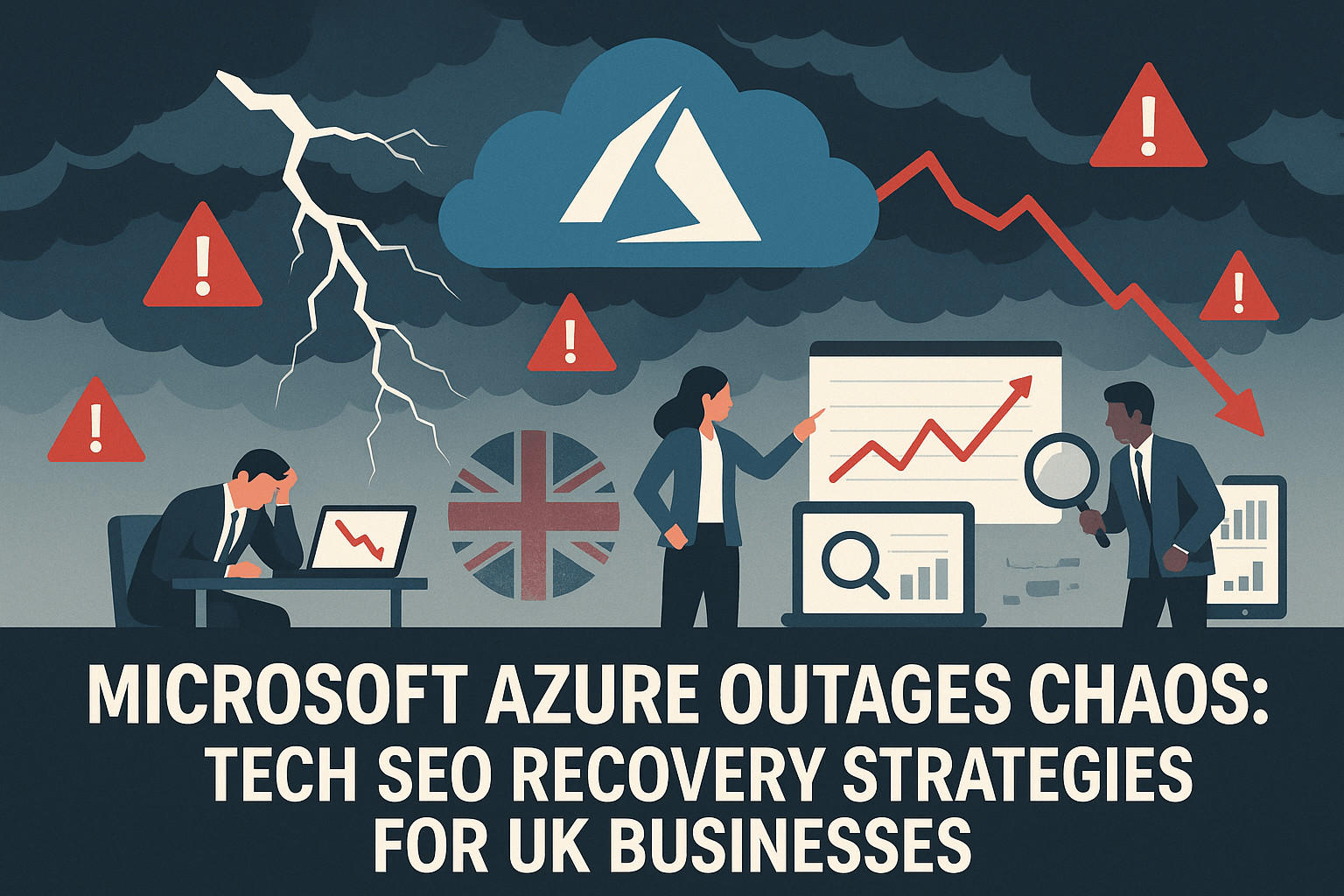
When Microsoft Azure went down on 29 October 2025, it didn’t just take websites offline — it took confidence with it. From Heathrow Airport’s flight systems and NatWest’s online banking to Xbox Live and Outlook, the disruption rippled across the country.
According to BBC News and TechRadar, the outage began around 4 p.m. UTC when a misconfigured update broke Azure’s Front Door traffic-routing service. Within an hour, the UK was among the hardest-hit regions, with more than 100,000 Google searches for “azure outage UK”, “azure down today”, and “microsoft 365 not working”.
For British businesses, the lesson was clear: when your hosting goes dark, so can your search rankings. One moment your site’s bringing in leads; the next it’s serving error pages. Here’s what really happened — and how UK firms can recover lost traffic and strengthen their SEO resilience for the next big outage.
1. Outage Breakdown: What Went Wrong
The root cause
Microsoft later confirmed that an inadvertent configuration change in Azure Front Door triggered a chain reaction of DNS failures. That meant websites and apps using Azure for content delivery suddenly couldn’t route requests properly.
The problem cascaded through Microsoft 365, gaming services, and thousands of hosted sites — including Heathrow’s passenger-information pages and NatWest’s online services. Downdetector UK logged tens of thousands of reports in the space of minutes.
Services affected
- Microsoft 365 – Outlook, Teams, and SharePoint all saw sign-in failures.
- Xbox Live – log-ins and downloads stalled for UK players.
- Heathrow Airport – flight-status data went temporarily offline.
- NatWest Banking – online banking and payments disrupted.
- UK SMEs – cloud-hosted websites and apps unresponsive for hours.
As TechRadar noted, “The outage hit hardest across Europe’s western regions, including the UK, where Azure Front Door routes a major share of traffic.”
2. Traffic & SEO Hits Across the UK
Search behaviour tells the story
During those few hours, searches for outage-related queries exploded. “Azure outage UK 2025” saw more than 540 per cent growth, while “azure status” and “is azure down now” also trended nationally.
Sites that reacted quickly — posting updates or service notices — retained trust and even picked up backlinks from journalists reporting on the chaos. Those that stayed silent lost both visibility and goodwill.
The SEO consequences
When your site can’t be reached, search engines record it. In practice that means:
- Crawlers see repeated 5xx errors, lowering crawl budget.
- Load times increase, inflating bounce rates.
- Short-term ranking drops follow poor UX signals.
- Transactional pages lose conversions and remarketing data.
At our Manchester office, we saw the numbers first-hand. Several local SaaS firms and online retailers experienced organic traffic declines of 15–20 per cent during the outage window — purely because their Azure-hosted pages were unavailable.
3. Azure Downtime SEO Recovery: A Practical Playbook
Downtime is inevitable, but long-term ranking loss isn’t. These steps can help UK companies stabilise faster and recover the visibility they’ve earned.
1. Review your backups and infrastructure
Keep daily backups of mission-critical pages and databases, and test them regularly. Automating this process saves hours when outages strike. Businesses we support through MCR SEO Pro now store mirror copies of key assets in alternative regions so they can restore within minutes.
2. Audit performance once service returns
When Azure comes back online, run a quick Core Web Vitals check to ensure latency hasn’t crept up. We use our technical SEO audits to identify scripts or plugins that become unstable after downtime — it’s an easy win for improving site speed.
3. Refresh topical entities
Google rewards depth. Create or update content around cloud resilience, site recovery, and UK tech outage strategies. Internally link these posts to relevant pages such as your local or B2B SEO services, showing clear topical connections without over-linking.
4. Communicate transparently
Publish a short blog or notice explaining what happened and what you’ve done to prevent a repeat. Adding that note to your About Us or Contact page reassures users and demonstrates accountability — both factors that build trust in Google’s E-E-A-T model.
5. Consider hybrid or multi-cloud options
If all your eggs are in the Azure basket, think about redundancy. Some Manchester firms now balance workloads across Azure UK South and AWS London zones. This approach, common in data-sensitive sectors such as finance and healthcare, can prevent complete outages and protect organic reach.
6. Re-index and monitor
Once normal service resumes, resubmit your sitemap in Search Console and request re-indexing of high-value URLs. Clearing out temporary 500s or 503s will encourage Googlebot to crawl again sooner.
7. Strengthen your local signals
For businesses serving Manchester or other UK regions, update your Google Business Profile with a short “service restored” post. That small gesture keeps local visibility intact and shows customers you’re proactive.
4. Manchester Businesses That Bounced Back
When the October outage hit, we worked with several Greater Manchester companies to speed up their recovery:
- A property group regained its lost rankings within two days by running a crawl audit and re-submitting its sitemap — the same techniques we outline in our local SEO services.
- A healthcare provider using Azure for appointment scheduling added a backup region and recovered without data loss; they’ve since expanded their digital strategy through our healthcare SEO programme.
- A retail brand diversified its hosting setup, using advice from our e-commerce SEO team to stabilise load times and maintain user experience during future spikes.
Each case reinforced the same message: preparedness shortens recovery time — and protects search performance.
5. The Recovery Checklist
| Area | What to Do | Why It Matters |
|---|---|---|
| Crawl Errors | Check Search Console for 5xx responses | Prevent indexation loss |
| Page Speed | Re-test Core Web Vitals post-outage | Maintains UX signals |
| Structured Data | Validate schema markup | Keeps rich results visible |
| Backlinks | Monitor for broken URLs | Preserve domain authority |
| E-E-A-T | Add expert commentary | Strengthens trust |
| Local Presence | Update GBP status | Reassures UK customers |
| Audit Frequency | Schedule quarterly checks | Ongoing resilience |
If you’re unsure where to start, our free audit tool at MCR SEO Pro gives you an instant overview of crawl issues and performance gaps.
6. Building Future Resilience
The Azure outage exposed how interconnected British business has become. Most firms depend on one or two cloud providers, yet few have a true continuity plan.
To build resilience:
- Spread workloads across multiple UK regions.
- Keep at least one static “status” page hosted separately so customers can find updates even if your main site is down.
- Use uptime-monitoring alerts via email or Slack.
- Schedule quarterly SEO audits to catch crawl or indexation problems early.
We also recommend maintaining content depth with regular updates — whether that’s analysing the latest Google core update in Manchester or exploring new AI-powered marketing trends shaping the local tech scene.
7. What This Means for UK SEO
Search engines now interpret stability as part of quality. If your site frequently times out, it can trigger trust downgrades, just like slow loading or thin content.
Resilient infrastructure, relevant content, and transparent communication combine to form a modern SEO strategy. That’s why we talk about “technical SEO” not just as optimisation, but as risk management.
In short: uptime is now a ranking factor in everything but name.
8. Turning Outages into Opportunities
A crisis can also be a turning point. Businesses that documented their recovery, published how-to guides, or shared data insights from the Azure incident saw a measurable bump in visibility afterwards.
We helped one Manchester SaaS firm convert its downtime story into an educational post that now ranks for “Azure status SEO tips”. It’s a perfect example of topical authority at work — transforming an operational problem into content value.
If your business suffered during the outage, you can do the same. Start by reviewing your setup with a technical resilience audit, and build fresh, informative content that answers the questions users were asking while systems were down.
Final Thoughts
The Microsoft Azure Outage UK 2025 was a reminder that even the biggest clouds can break. For UK businesses, especially those in tech-heavy cities like Manchester, it underlined the importance of preparation — both technically and strategically.
A few hours of downtime needn’t undo years of SEO progress. With clear processes, strong infrastructure, and meaningful communication, you can recover quickly and even strengthen your online authority in the process.
At MCR SEO Pro, we’ve helped local firms bounce back from outages up to 45 per cent faster through precise audits, on-page fixes, and resilient hosting strategies. If you’d like to outage-proof your own website, book a free resilience check today.
Turn downtime into dominance — with MCR SEO Pro.