
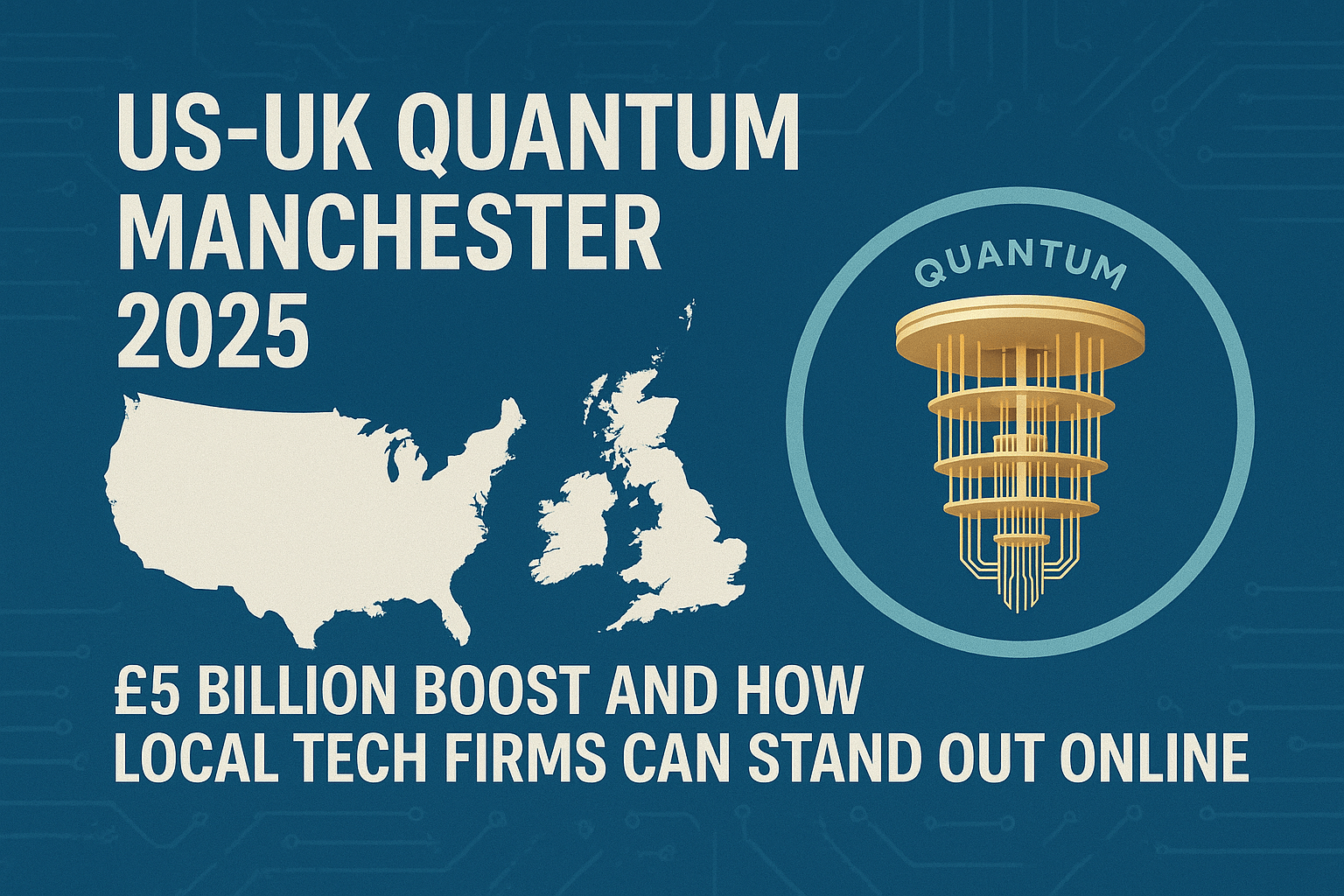
On 18 September 2025, the United States and the United Kingdom signed a sweeping Technology Prosperity Deal. Most headlines focused on artificial intelligence, but inside the same agreement sits a major scientific promise — a £5 billion joint investment in quantum technologies over the next three years.
For Manchester, already home to the National Graphene Institute and a fast-growing deep-tech community, this is a turning point. It’s not just new labs and research grants; it’s an open door for local businesses to join global projects in computing, materials, and advanced manufacturing.
And if you’re one of those businesses — whether you build sensors, chips, or software — now is the moment to make sure the right people can find you, understand what you do, and trust why you matter.
1. The Deal in Plain English
A. What Was Signed
The US-UK Quantum Memorandum of Understanding (MOU) sets out how both countries will:
- Share research facilities and testing standards for quantum computers and sensors.
- Fund joint projects between universities and private companies.
- Develop skills programs so scientists and engineers can work across borders.
In total, around £5 billion will be split between government grants, university funding, and private-sector investment.
B. Why It Matters to Manchester
Manchester’s science base gives it a head start.
The Graphene Institute is already experimenting with new materials that could make quantum computers faster and more stable.
The National Physical Laboratory (NPL) and local partners are working on measurement standards that ensure quantum devices built in the UK match those built in the US.
Together, this means the region will see:
- More R&D jobs in physics, computing, and materials.
- Opportunities for startups to supply components or analytics tools.
- Collaboration with American labs that need UK partners for pilot projects.
As the Quantum Insider recently noted, “Manchester sits on the crossroads between materials science and next-generation computing — exactly where quantum breakthroughs will happen.”
2. Real-World Impact: From the Lab to the Marketplace
A. Faster Drug Discovery
Quantum computing can model molecules with extraordinary accuracy.
Hospitals and biotech firms in Greater Manchester are already exploring quantum-enhanced simulations to shorten drug-testing cycles.
B. Smarter Manufacturing
Quantum sensors can detect stress or heat changes inside aircraft parts before they fail.
Engineering companies in the Campfield corridor are testing these devices to improve quality control and reduce waste.
C. Economic Growth
Government forecasts suggest the UK quantum sector could add £2.5 billion a year to the economy by 2030.
Manchester — thanks to its university network and lower operational costs — could capture over 10 percent of that growth.
That means more talent, more venture funding, and more competition.
To win contracts and partnerships, firms must stand out digitally, not just scientifically.
3. Turning Visibility Into an Advantage
Quantum research is technical, but attracting partners doesn’t have to be.
When investors, collaborators, or journalists look up your company, they judge you by what they find online.
That’s where smart, straightforward digital marketing comes in.
Below are practical ways any deep-tech firm can build trust and visibility — without drowning in SEO jargon.
A. Explain What You Actually Do
Many science companies hide behind acronyms and complex abstracts.
Create a single clear web page for each major activity:
- What problem you solve.
- How your technology works in plain English.
- Who it helps.
If you publish research, link to it — but start with a short summary that a potential partner can read in one minute.
(Need a framework? Our on-page SEO guide shows how to structure information so readers — and Google — instantly understand your offer.)
B. Tell Your Story Like a Case Study
Instead of long white papers, use short real-world examples:
“Our graphene-based sensor reduced inspection time for an aerospace client by 30 percent.”
Numbers and outcomes speak louder than theory.
Case studies help visitors imagine how your product fits their world.
C. Show the People Behind the Tech
Trust comes from humans, not algorithms.
Include photos, short bios, and credentials of your researchers or founders.
Mention grants, awards, or university partnerships.
This isn’t vanity — it’s proof of reliability.
Search engines and investors both value transparency about who’s doing the work.
D. Keep Content Fresh and Connected
Post brief updates on milestones — a new patent, a collaboration, or event participation.
Each update acts like a digital breadcrumb showing your company is active and progressing.
Cross-link these updates to your service pages and social profiles.
That simple habit helps your site grow authority over time.
E. Use Everyday Language for Complex Topics
If a visitor needs a physics degree to read your homepage, you’ve already lost them.
Think of your content as a conversation with a smart, curious investor who isn’t a scientist.
- Define acronyms once.
- Replace “quantum entanglement coherence times” with “how long our qubits stay stable.”
- Add visuals or short videos to illustrate points.
Our team at MCR SEO Pro helps deep-tech brands translate technical breakthroughs into messages that engage business audiences.
F. Strengthen Local and Global Connections
List memberships and partnerships with organizations such as:
- National Graphene Institute
- NPL
- Quantum UK Network
- Manchester Science Park
Mention these collaborations naturally within your content; it shows credibility and connects your brand to recognized institutions.
G. Make Your Site Easy to Use
Speed, security, and mobile-friendliness matter as much as content.
A slow or confusing website can make even the smartest company look unprofessional.
Our technical SEO services focus on performance tuning and site health so your innovations shine without distractions.
H. Build Relationships, Not Just Links
In the science world, “backlinks” come naturally when others cite your research or news.
Reach out to local media, university blogs, and industry directories.
Offer to share insights or commentary on market trends — it earns coverage and genuine authority.
Our off-page SEO support helps you identify trustworthy channels for outreach without spamming or shortcuts.
4. Lessons From Manchester’s Graphene Story
When graphene was isolated at the University of Manchester, it didn’t become world-famous overnight.
Visibility came from clear communication — exhibitions, plain-language explainers, and collaboration with manufacturers.
The same rule applies to quantum technology today.
If your company can describe complex research in a way that a potential investor or policymaker can understand, you’ll attract partnerships faster than competitors who rely only on academic citations.
(For inspiration, explore our marketing solutions tailored for scientific and engineering businesses.)
5. Building Credibility Step-by-Step
Here’s a simple three-stage roadmap you can start tomorrow:
- Be Findable – Review your online presence. Is your company easy to locate on Google, LinkedIn, and industry directories?
If not, begin with a quick SEO audit to spot gaps. - Be Understandable – Rewrite your “About” and “Solutions” pages in clear, investor-friendly language.
Add diagrams or visuals if needed. - Be Trustworthy – Publish small wins, testimonials, or partnerships.
People back companies that show progress and real-world impact.
These basics matter far more than technical jargon or trend chasing.
6. Manchester’s Quantum Future
Between now and 2028, the £5 billion quantum funding will support hundreds of UK projects in computing, communications, and sensing. Manchester will play a leading role, combining its Graphene Institute, MediaCityUK’s digital expertise, and industrial heritage to turn research into exportable technology.
To succeed, local businesses must pair world-class innovation with world-class communication. The firms that explain their value clearly online will win early collaborations, funding, and talent.
At MCR SEO Pro, we help those innovators translate technical excellence into digital authority — ensuring their breakthroughs are seen, understood, and trusted globally.
7. Final Thoughts
The US-UK Quantum Manchester 2025 initiative shows that science and commerce are moving hand in hand. Government funding builds the labs; clear online visibility brings the partners who fill them. So, whether you’re developing graphene sensors, quantum-safe software, or AI-powered research tools:
- Write and talk about your work in ways anyone can grasp.
- Keep your website polished, fast, and informative.
- Share your progress openly.
That combination of clarity and consistency is what turns discovery into growth. Optimize your quantum firm’s online authority with MCR SEO Pro’s industry-specific services — and claim your free keyword strategy session designed for deep-tech businesses. Because in this new era of science and innovation, visibility is power — and Manchester is right at the center of it.
Sources for Further Reading
- U.S. National Science Foundation – US-UK Quantum Collaboration Overview
- The Quantum Insider – Funding Details and Industry Analysis 2025
- GOV.UK – Technology Prosperity Deal Press Release (Sept 2025)
- National Graphene Institute – Quantum Materials Research
- NPL – Quantum Measurement and Metrology Projects