The Complete SEO Guide for Solicitors

Solicitor SEO helps law firms improve their visibility on search engines, rank for high-value local and service-based keywords, and attract qualified leads without relying solely on referrals or paid ads. For example, queries like “family solicitor near me” or “property conveyancing in Manchester” generate consistent traffic when optimised correctly.

But legal SEO isn’t one-size-fits-all. Google classifies solicitor websites under YMYL (Your Money or Your Life), meaning your content, site structure, and reputation must meet a higher standard. Without demonstrating expertise, trust, and legal authority, your site may struggle to rank—regardless of how well-written it is.

This guide provides solicitors, legal marketers, and law firm owners across the UK with a comprehensive framework to enhance online visibility while ensuring compliance with legal marketing regulations. You’ll learn:

  • How legal clients search for solicitors online
  • Which SEO strategies work best for UK law firms
  • How to structure your website for trust, rankings, and conversions
  • What tools, schema, and signals boost legal visibility
  • How to choose an SEO partner who understands legal compliance

If you’re looking for expert help optimising your legal website, MCR SEO Pro provides solicitor-focused SEO services built to meet both Google’s standards and your firm’s growth goals.

How Do UK Legal Consumers Search for Solicitors Online?

In the UK, over 84% of people trust Google to evaluate local service providers—including solicitors. Legal consumers don’t just type a service name; they search with urgency, intent, and context. This behaviour directly influences how law firms should structure their SEO strategy.

Common Search Patterns:

  • Location-based terms
    e.g. “immigration solicitor Liverpool”, “property lawyer near Sheffield”
  • Service-specific queries
    e.g. “child custody lawyer UK”, “no win no fee solicitor”
  • Reputation-led searches
    e.g. “best divorce solicitor Manchester”, “top-rated family law firm near me”
  • Comparison-style searches
    e.g. “solicitor vs barrister for housing”, “fixed fee vs hourly rate solicitor”
  • Branded vs non-branded intent
    Over 63% of legal searches are non-branded, meaning users don’t search for a firm’s name—they search for the service.

Search Behaviour Trends:

TrendUser BehaviourSEO Implication
Mobile-first usageOver 70% of legal searches happen on smartphonesSites must be responsive and fast
Zero-click resultsFeatured snippets and local packs dominateContent should answer queries directly
Voice search growthPeople ask full legal questions aloudUse long-tail and natural language keywords
Local SEO biasGoogle prioritises location + reviewsBuild a strong Google Business Profile and local signals
Directories vs OrganicLegal directories still rank highCompete with them or optimise for them

Legal consumers in the UK choose solicitors based on proximity, ratings, clear service offerings, and professional trust. Your SEO must address all four dimensions—not just keywords—to rank and convert.

Next, we’ll explore the specific SEO challenges that make the legal sector one of the most competitive and scrutinised by Google.

What SEO Challenges Are Specific to Law Firms and Solicitors?

Solicitors operate in a tightly regulated, high-trust industry—making legal websites subject to stricter SEO scrutiny than standard businesses. Google places them in the YMYL (Your Money or Your Life) category, meaning ranking depends not only on relevance but on credibility, authority, and compliance.

Here are the most critical SEO challenges law firms face in the UK:

1. Higher E-E-A-T Requirements

Google demands clear expertise, authoritativeness, and trustworthiness from solicitor websites. Firms without visible legal credentials, verifiable authors, or clear company information risk being filtered out—even with well-optimised content.

Example: A blog about child custody written by an anonymous “content team” is unlikely to outrank one written or reviewed by a qualified family solicitor.

2. Strict Legal Advertising Rules

UK solicitors must follow SRA and ASA guidelines when marketing online. This limits:

  • Exaggerated claims (e.g. “the best solicitor in London”)
  • Misleading success guarantees
  • Client testimonials without verification

These restrictions apply to on-page content, headings, meta titles, and even schema.

3. Overcrowded Local SEO Landscape

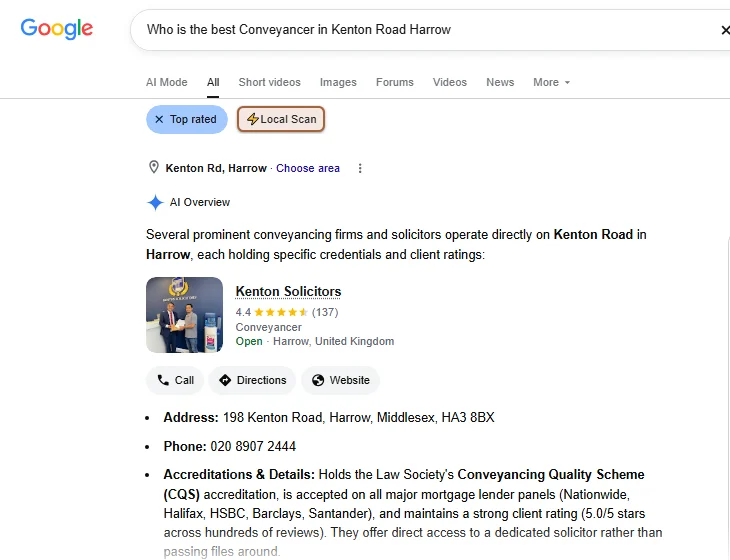
Cities like Manchester, London, and Birmingham are saturated with competing firms. Appearing in the local 3-pack requires:

  • Fully optimised Google Business Profile
  • Consistent NAP (Name, Address, Phone) data across directories
  • Active review acquisition and management
  • Geotargeted service pages with unique content

Local visibility isn’t just about location—it’s about precision, consistency, and trust.

4. Duplicate or Thin Content Across Service Pages

Many firms copy content between practice areas or city pages, which leads to:

  • Keyword cannibalisation
  • Thin content penalties
  • Lack of topical uniqueness

Each page should focus on a distinct search intent, use localised language, and offer specific legal value.

5. Missing or Weak Structured Data

Legal websites that ignore schema markup limit their visibility. Without a LegalService, Organization, or FAQPage schema, Google can’t fully understand the page’s function, credibility, or connections to the Knowledge Graph.

Structured data also impacts eligibility for:

  • Featured snippets
  • Local business panels
  • FAQs and How-Tos in SERPs

6. Inconsistent Entity Signals

Google uses signals across the web to build a complete picture of your law firm. Discrepancies in:

  • Business names
  • Author bios
  • Legal accreditations
  • Review platforms

…can confuse Google’s understanding of your brand entity. The result: lower rankings even with good content.

These challenges make solicitor SEO uniquely difficult. The stakes are high, and competition is fierce. Overcoming them requires legal expertise, technical precision, and an SEO strategy aligned with both compliance and Google’s semantic expectations.

What Are the Most Effective SEO Strategies for UK Solicitor Websites in 2025?

SEO for solicitors in the UK demands more than basic optimisation. Because law firm websites fall under Google’s YMYL (Your Money or Your Life) category, they’re assessed for trust, legal credibility, and semantic clarity—especially following updates like the Medic Update, Helpful Content System, and MUM.

The strategies that work best are those that align with Google’s evolving understanding of entities, intent, and trustworthiness.

1. Build an Entity-Based Site Structure

Since Google’s Hummingbird and BERT updates, semantic relevance and entity relationships have outweighed keyword stuffing. Solicitor websites should be structured by topic silos—grouping pages by service area (e.g. family law, conveyancing) and supported by internally linked subtopics.

Example: /family-law/child-custody-london semantically connects practice area + service + location.

This structure helps Google’s MUM algorithm understand how legal services relate across practice areas, geographies, and user intent.

2. Optimise for Local Search and Proximity Relevance

The Vicinity Update shifted local SEO toward proximity-based ranking, making it critical for law firms to have consistent NAP (Name, Address, Phone) data, an optimised Google Business Profile, and localised service pages.

Unique location pages (e.g. “property solicitor Manchester”) must include contextual legal language and client-relevant details—Google now prioritises local intent + relevance, not just distance.

3. Publish Legally Accurate Content Reviewed by Experts

Since the Medic Update (2018), content in the legal space is held to high standards for expertise and factual integrity. Google expects solicitor websites to:

  • Use named authors with legal credentials
  • Include solicitor bios linked to their profiles
  • Avoid publishing anonymous or AI-generated content in sensitive practice areas

The Helpful Content System further penalises law firm blogs that are generic, outsourced, or duplicated across sites.

4. Design for Conversion and UX Signals

Following the Page Experience Update and Core Web Vitals, Google factors in how well a page satisfies a user’s intent—not just if it contains the right keywords.

Law firm websites should prioritise:

  • Clear CTAs (e.g. “Speak to a solicitor now”)
  • Fast mobile load speeds
  • Professional design and structured layouts
  • Trust markers like SRA accreditation, reviews, and contact verification

Pages that convert well tend to rank better over time due to stronger engagement metrics.

5. Use Structured Data to Reinforce Legal Entities

Google’s understanding of law firm websites is enhanced through schema markup. Without it, even strong content can underperform.

Essential structured data types include:

  • LegalService to describe your offerings
  • Organization and LocalBusiness to identify your firm
  • BreadcrumbList to improve crawlability and internal hierarchy
  • FAQPage for question-rich legal content

Schema helps connect your firm to the Knowledge Graph, improving topical relevance and eligibility for rich results.

6. Create and Update Topical Content Clusters

Legal search queries are often long-tail and question-based. Google’s Passage Ranking (2021) now enables parts of your content (not just full pages) to rank—making structured, information-rich content even more valuable.

High-performing solicitor sites in 2025:

  • Build blog clusters around key legal topics (e.g. divorce process UK, how conveyancing works)
  • Answer PAA (People Also Ask) questions directly
  • Refresh old content to reflect law changes or case updates
  • Internally link pages to reinforce topical authority

Continuous, structured content builds entity strength and shows search engines you’re the best source on a topic.

The strategies above aren’t “best practices”—they’re requirements in a post-MUM, post-Helpful Content era. For solicitors, SEO isn’t just about visibility. It’s about proving your expertise, aligning with legal compliance, and matching how real clients search.

To apply these strategies effectively, your website needs to be structured in a way that supports both legal context and Google’s entity-driven interpretation of services.

How Should Solicitors Structure Their Websites for SEO?

A solicitor’s website must do more than look professional — it must mirror how Google understands entities, services, and intent. The structure should support semantic clarity, crawling efficiency, and legal credibility. Without this, even strong content can underperform in search.

Google’s algorithms, including MUM, BERT, and Helpful Content, rely on well-defined structure to understand what your site is about, how your content connects, and whether it satisfies user intent.

Use a Topical Silo Structure Based on Legal Services

Start by grouping content into practice-area silos. Each major legal service — family law, immigration, employment law — should have its own parent URL with internal pages for subtopics.

Example:

/family-law/  

/family-law/child-custody/  

/family-law/divorce-finances/  

This hierarchy allows Google to interpret your content semantically and link it to relevant legal entities in the Knowledge Graph.

Optimise for Local Intent with City-Specific Pages

Location pages should contain more than just modified keywords. Each page should include:

  • Legal context for that specific location
  • Local courts, client types, and jurisdiction differences
  • Testimonials or results from clients in that region

Avoid duplicating content across cities. Google’s Vicinity Update prioritises relevance and proximity—so each page must offer unique, location-aware value.

Strengthen Internal Linking Based on Entity Relevance

Internal links must follow a semantic logic, not just navigation flow. Link related topics together using natural anchor text that mirrors real legal relationships.

Example:
Link “redundancy advice” to “employment tribunal representation” using meaningful phrases, not generic “click here” links.

This helps Google interpret entity relationships through its discourse parsing and link graph models.

Align URL Structure and Menus with Topical Hierarchy

Avoid flat or non-descriptive URLs like /services/page1.html. Use paths that reinforce your topical silos.

Recommended format:

/employment-law/ 

/employment-law/unfair-dismissal/  

Menus should reflect this same hierarchy — grouping services under practice areas — and remain consistent across desktop and mobile layouts.

Segment Pages by Search Intent and Function

Structure your website around searcher intent, not just services.

  • /services/ → Transactional / commercial intent
  • /guides/, /knowledge/, /faq/ → Informational intent
  • /about/, /team/, /testimonials/ → Trust-building content

This helps both users and search engines understand the purpose of each section and supports query–document alignment.

Support Structure with Schema Markup

Structured data reinforces your site’s semantic architecture.

Include:

  • BreadcrumbList schema to define content hierarchy
  • WebPage and About schema to clarify page relationships
  • SiteNavigationElement schema for major menu links

These schemas help Google parse your navigation and understand how entities are linked within your site.

Ensure Crawlability and Indexation Efficiency

Google prioritises sites it can crawl and interpret efficiently. To support that:

  • Create an XML sitemap grouped by content type or silo
  • Avoid orphan pages and maintain shallow crawl depth
  • Use canonical tags to prevent duplication across location or service pages

Technical clarity supports topical clarity. A well-structured solicitor site isn’t just easier to crawl — it’s easier for Google to classify and rank.

A legal website with this kind of structure sends clear, consistent signals about what services are offered, where they’re offered, and who provides them. This isn’t just about SEO — it’s about showing Google that your law firm is a trusted, authoritative entity that answers real legal queries.

What Keyword Strategy Should Solicitors Follow in 2025?

Modern SEO for solicitors isn’t about chasing high-volume keywords — it’s about matching the language your clients use, understanding their search intent, and building content that clearly reflects your legal services.

Search engines now evaluate not just words, but meaning, relevance, and context. The best-performing solicitor websites in 2025 use keyword strategies that reflect how legal consumers think, search, and decide.

Focus on Search Intent, Not Just Keywords

Instead of starting with “high search volume” terms, focus on the reasons behind someone’s search. Legal searchers typically fall into four categories:

Intent TypeExample QueryBest Content Match
Transactional“Property solicitor London”Service page
Informational“What does a family solicitor do?”Guide or blog
Investigational“Best conveyancing firms near me”Comparison page with trust signals
Navigational“MCR SEO Pro contact details”Contact/About page

Matching search intent with the right content type improves rankings and conversion because it satisfies what the user actually wants.

Build Topics Around Entities, Not Just Exact Phrases

Search engines group semantically related terms and expect websites to cover them as connected topics, not isolated keywords.

Instead of targeting just “divorce solicitor”, include related terms like:

  • Family lawyer
  • Child custody solicitor
  • Divorce mediation services
  • Spousal maintenance legal help

These aren’t variations—they’re entity attributes of the same topical graph. Covering these creates more opportunities to rank and shows subject expertise.

Use Topic Clusters to Build Relevance

Each practice area should be treated as a topical hub, supported by guides, FAQs, and informational pages.

Example cluster: Employment Law

  • Can I be dismissed without warning?
  • What is constructive dismissal in the UK?
  • How to file a claim at the employment tribunal
  • How much compensation can I claim for unfair dismissal?

Covering these topics shows depth. Pages aren’t optimised around one keyword—they’re built around solving a legal problem fully.

Map Keywords to the Right Page Type

Every keyword belongs to a specific type of page. Mixing them up weakens performance.

Page TypeKeyword Type
HomepageBroad legal terms + brand (e.g. “solicitors in London”)
Service PagesActionable, location-based (e.g. “conveyancing solicitor Manchester”)
Blog PostsQuestions, informational searches (e.g. “What is probate?”)
FAQ PagesConversational, answer-style (e.g. “Can I sue my landlord for mould?”)
Location PagesGeo-targeted queries (e.g. “divorce solicitor Leeds”)

Correct mapping helps search engines understand the purpose of each page and improves user experience.

Don’t Rely Solely on Search Volume

Legal terms with low or zero reported search volume can still generate leads. Many legal queries are long-tail and specific.

Instead of relying only on tools, use:

  • People Also Ask boxes
  • Google’s Related Searches
  • Legal directories
  • Google Search Console queries

Often, the highest-converting leads come from niche, problem-focused searches.

Include Synonyms, Plural Forms, and Common Phrasings

Clients may search for the same service using a different language. Your content should naturally include:

Variation TypeExample
Synonym“Lawyer” vs. “Solicitor”
Pluralisation“Divorce solicitors” vs. “divorce solicitor”
Colloquial“Free legal help” vs. “legal aid solicitor”
Layperson terms“Sack” vs. “dismiss” in employment law

This increases semantic coverage and ensures you’re visible for more variations of the same search intent.

Stay Consistent Across All Entities

If your site uses “employment lawyer” on one page and “HR solicitor” on another without context, it can confuse search engines.

To avoid this:

  • Use consistent terminology within topic clusters
  • Connect similar terms with internal links and supporting content
  • Reinforce meaning using schema and internal structures

Consistency helps search engines understand your entity relationships, which supports trust and higher rankings.

Keyword strategy in 2025 isn’t about chasing numbers. It’s about structuring content around topics, entities, and intent, while making sure it reflects how people actually search for legal help in the UK.

How Does Content Marketing Help Solicitors Rank Higher?

For UK law firms, content marketing isn’t just a visibility tool — it’s a way to prove legal expertise, build trust, and cover the full scope of user intent around each legal service. In a YMYL category like law, publishing high-quality content is essential for building topical authority and satisfying Google’s quality signals.

Content Signals Authority in High-Stakes Legal Queries

Solicitor websites must demonstrate an understanding of the legal issues people are searching for. Content helps you:

  • Answer informational queries early in the customer journey
  • Prove legal understanding without pushing services directly
  • Match long-tail and question-based searches that service pages can’t cover

Publishing structured legal guides, case studies, FAQs, and explainer articles expands your entity coverage and makes your site more visible across diverse search terms.

Example: A firm that handles “redundancy claims” should also answer:

  • What is unfair dismissal?
  • Can I be fired without notice?
  • What compensation can I claim from a tribunal?

Each piece of content connects to a broader topic graph, increasing your chances of ranking and reinforcing subject expertise.

Supports Topical Authority and Semantic Depth

Google expects authoritative legal websites to cover topics comprehensively. That doesn’t mean writing one long blog post — it means building interconnected content clusters.

Content cluster example for family law:

  • Overview: What does a family solicitor do?
  • Subtopics: Divorce process, child custody laws, spousal maintenance
  • FAQs: Who gets custody in the UK? Can I get a quick divorce?
  • Guides: How to prepare for family court, Legal aid options in family law

Each article supports the central service page and reinforces relevance.

This strategy helps your site rank for:

  • People Also Ask queries
  • Long-tail keywords
  • Passage-based indexing (specific sections answering legal questions)

Content Builds Trust and Conversion, Not Just Traffic

Legal clients need confidence before contacting a solicitor. Strategic content demonstrates that your firm:

  • Understands their legal problem
  • Can explain it in plain English
  • Offers relevant solutions backed by legal context

Use content to show:

  • Real case examples (anonymised)
  • Explanations of legal rights and processes
  • Answers to common fears (e.g. “Will it cost me if I lose?”)

Helpful content reduces hesitation and shortens the path to enquiry.

FAQs and Informational Pages Improve Semantic Coverage

Many legal queries start with “Can I…”, “How do I…”, or “What happens if…”. These questions deserve their own pages — not just a few lines on a service page.

Well-structured FAQs:

  • Capture zero-click search traffic
  • Increase session duration
  • Help Google classify your site as a reliable source for legal advice

Pair FAQs with the FAQPage schema to increase eligibility for rich results.

Regular Publishing Signals Activity and Freshness

Content velocity supports visibility over time. Google prefers sites that are actively maintained — especially in sectors where the law changes frequently.

  • Update core pages with new case law, legislation, or SRA guidance
  • Add new questions as you identify real-world client concerns
  • Internally link between related pages to reinforce the topic graph

Law firms that publish regularly tend to dominate rankings over static websites.

Content marketing in the legal industry isn’t about volume — it’s about clarity, coverage, and relevance. A well-planned content strategy builds visibility, supports EEAT, and creates a conversion pathway for people searching with intent.

How Important Is Local SEO for UK Solicitors?

Local SEO is critical for solicitors because most legal clients begin with geographically modified searches. Queries like “family solicitor near me”, “immigration lawyer Birmingham”, or “property solicitor in Manchester” reflect immediate intent and are tied to real-world service locations.

Google ranks legal service providers not just based on keywords, but on a firm’s relevance, proximity, and prominence within a local context. For UK solicitors, this means more than just having a Google Business Profile — it means semantic consistency, accurate location signals, and trust indicators that support your legal entity in the map and organic results.

Google Business Profile Is Your Most Valuable Local Asset

A well-optimised Google Business Profile (GBP) strengthens your firm’s local authority. Google relies on this listing to understand your office location, service scope, and credibility.

To maximise your GBP impact:

  • Use the correct legal business name (no extra keywords)
  • Match your NAP (name, address, phone) to your website exactly
  • Choose categories like “Family Law Solicitor”, not just “Law Firm”
  • Add services, legal practice areas, office hours, and a full business description
  • Use real, client-friendly photos of the office and team

Inconsistent or incomplete GBPs often cause ranking drops in the local 3-pack.

Location Pages Must Offer Unique Legal Value

Many solicitors clone location pages with minor edits — this approach is no longer effective. Google now prioritises location-specific legal relevance, not just city names in H1 tags.

Each location page should include:

  • Details about the specific legal landscape in that area (e.g. local courts, housing issues, employment norms)
  • Localised testimonials or case examples
  • Solicitor profiles tied to that region
  • Service explanations tailored to local demand

Example: “Conveyancing in Liverpool” should address local leasehold trends, while “Conveyancing in Leeds” might highlight common new build issues.

Local Citations and Reviews Reinforce Entity Trust

Beyond your website, Google checks off-page signals to assess your firm’s local authority. These include:

  • Reviews on legal platforms like ReviewSolicitors, Trustpilot, and Yell
  • Mentions on local news sites, blogs, or business directories
  • Consistent NAP across all listings

Encourage satisfied clients to leave reviews with details about their case type and location — this creates entity-rich sentiment data that search engines can parse.

Local SEO Is Conversion-Driven

Local traffic often converts better than informational traffic. A searcher typing “child custody solicitor Hackney” is closer to making contact than someone reading about family law procedures.

Optimised local SEO helps your firm:

  • Appear in map listings and mobile searches
  • Receive more high-intent enquiries
  • Reduce dependency on paid ads

It also supports EEAT by aligning your legal services with real-world locations where you’re regulated and qualified to practise.

Local SEO isn’t a niche tactic — it’s a core component of solicitor visibility. Google must be able to connect your entity to a geographic space, with consistency, clarity, and legal context. For most UK law firms, local optimisation is the most direct path to ranking higher and acquiring qualified leads.

How Can Solicitors Use Link Building Ethically and Effectively?

For solicitors, link building is less about volume and more about authority, context, and relevance. In a regulated YMYL niche like legal services, unethical or manipulative link building can damage rankings, reputation, and compliance.

Effective link building for law firms requires a focus on earning contextual mentions from trusted sources within legal, local, and informational ecosystems.

Why Link Building Still Matters in Legal SEO?

Google still uses backlinks to assess a site’s authority and trustworthiness. For solicitors, high-quality backlinks support:

  • Entity recognition (connecting your firm to legal topics and geographic areas)
  • Crawl prioritisation (important pages get indexed faster)
  • Topical authority (sites linked by legal and high-E-E-A-T sources gain stronger trust signals)

But not all links are equal — and in legal SEO, irrelevant or manipulative links can cause devaluation or manual actions.

Link Sources That Are Safe and Valuable for Solicitors

Koray’s framework and Google’s guidelines both favour earned links that are:

  • Contextually relevant
  • Entity-aligned
  • Editorially given (not paid or artificially embedded)

High-quality link opportunities include:

  • Legal directories: ReviewSolicitors, Law Society Find a Solicitor, Yell Legal, JustCite
  • Local authority sites: Chambers of commerce, regional news, legal events
  • Legal associations: Membership badges that link to your site (e.g. Resolution, STEP, APIL)
  • University or law school mentions: For alumni solicitors or guest lectures
  • Niche guest posts: Contributed articles on law-focused publications

Avoid mass guest post marketplaces or irrelevant blog networks — these violate quality guidelines and dilute topical focus.

Build Links Through Topical Legal Content

Content marketing supports natural link acquisition when it targets:

  • Journalistic questions: e.g. “What are my rights if dismissed unfairly?”
  • Timely legal updates: Commentary on new laws or regulations
  • Unique data or guides: e.g. A downloadable eviction checklist for tenants in Manchester

This type of content is more likely to earn citations from:

  • Journalists
  • Bloggers
  • Local press
  • Non-competing firms

To improve link attraction, publish with author bios and clear sourcing to enhance credibility and citation appeal.

Avoid Link Schemes That Risk Penalties

Link schemes are still common in the legal space — and still dangerous.

Solicitor websites should avoid:

  • Buying backlinks from unrelated sites
  • Link exchanges or reciprocal linking networks
  • Low-quality directory submissions
  • Anchor text over-optimisation (e.g. exact-match phrases across all links)

Google’s link spam update (2022) targeted many law firms using these tactics, and recovery often requires disavowing links and rebuilding trust.

PR and Link Acquisition for Law Firms

Digital PR can be a powerful, white-hat link-building tool. Law firms can earn press and links by:

  • Sharing legal insights on newsworthy topics
  • Commenting on breaking legal stories
  • Partnering with local initiatives or charities
  • Launching research-driven campaigns (e.g. surveys on tenant disputes or divorce trends)

These efforts generate editorial backlinks, improve visibility, and strengthen your firm’s position as a trusted legal voice.

Link building for solicitors isn’t about volume or tricks. It’s about contextual authority, relevance to the legal field, and clear entity alignment. Earning high-quality links from real sources builds lasting trust with both users and search engines — while keeping your site safe from algorithmic devaluation.

Which Legal SEO Schema Should Solicitors Use for Rich Results?

Schema markup allows search engines to understand better the meaning, structure, and purpose of your content. For solicitor websites, using the right schema not only improves indexation accuracy but also enables rich results that boost visibility, trust, and click-through rates.

Schema acts as a machine-readable context that aligns your legal entity with the topics and services you offer. Without it, search engines may misinterpret your content or overlook key signals—especially in competitive, trust-sensitive verticals like law.

Why Schema Matters in Legal SEO?

Search engines rely on structured data to:

  • Identify your firm as a legal entity
  • Understand what services are offered and where
  • Link your content to the correct place in the Knowledge Graph
  • Enhance listings with features like FAQs, reviews, and sitelinks

For solicitors operating under YMYL and EEAT constraints, schema helps reinforce the signals Google expects from trustworthy legal websites.

Essential Schema Types for Solicitor Websites

Each schema type serves a specific purpose in clarifying your content’s meaning. Here are the most important ones for law firms:

1. LegalService
Defines your firm’s legal offerings in a structured way. Helps search engines understand your practice areas.

  • Use @type: LegalService for core service pages
  • Include areaServed, availableChannel, and serviceType properties
  • Example: serviceType: Conveyancing, areaServed: Greater Manchester

2. Organization or LocalBusiness
Describes your law firm as an operating legal entity.

  • Add legalName, address, telephone, sameAs (for social profiles)
  • Use LocalBusiness if you operate in a defined location (physical office)
  • Include founder, priceRange, openingHours, and accreditation mentions

3. BreadcrumbList
Clarifies the page’s place in your website hierarchy.
Improves crawl paths and may show in SERPs.

  • Use for every page in your siloed structure
  • Follows your navigational menu logic

4. FAQPage
Enhances content with dropdown answers directly in search results.
Must match actual on-page content and structure.

  • Use only where real FAQs are present
  • Improves engagement, time-on-page, and snippet visibility

5. WebPage + About + Mentions
Helps define the topic and associated entities of a given page.

  • about → should link to entities (e.g. [“Divorce Law in the UK”])
  • mentions → connects your page to semantically related subjects (e.g. [“Child Custody”], [“Legal Aid”])

Optional but Useful Schema for Solicitors

  • Review → If you publish third-party verified testimonials
  • Person → If publishing solicitor bios (use with SRA ID, credentials, job title)
  • Article → If your blog is set up as a publishing section with an editor/reviewer

Use structured data validators like Schema Markup Validator or Google’s Rich Results Test to check implementation.

Common Schema Mistakes to Avoid

  • Using the FAQ schema on non-question content
  • Copy-pasting an identical schema across location pages
  • Failing to update structured data when services change
  • Missing context-rich properties (e.g., linking service areas, lawyer names, or court jurisdictions)

Structured data must reflect the actual content and unique entities on each page to remain compliant and effective.

Schema doesn’t directly increase rankings, but it does improve how your content is interpreted, displayed, and trusted. For solicitor websites, using the right schema types helps strengthen your presence in the SERP and clarify your role as a credible, expert-driven legal service provider.

How Should a Solicitor’s Website Handle Mobile and UX SEO?

Mobile SEO and UX are not optional for solicitors — they’re critical. Most legal clients now use mobile devices to search for immediate legal help. Whether it’s “employment solicitor near me” or “urgent divorce lawyer”, users expect fast, clear, and trustworthy websites they can act on instantly.

Google uses page experience signals to evaluate content quality, including mobile usability, speed, visual stability, and ease of interaction. For law firms, these directly affect rankings, user trust, and lead conversion.

Mobile Optimisation Is a Legal UX Standard

Mobile searches in legal sectors carry urgency. The device often reflects the mindset of its users, who are either in motion or under stress. Your site must respond to that state.

To support mobile SEO:

  • Use a responsive layout that adapts to all screen sizes
  • Set the meta viewport tag correctly (<meta name=”viewport” content=”width=device-width, initial-scale=1″>)
  • Keep all tap targets (like buttons and phone numbers) at least 48px apart
  • Avoid interstitials or pop-ups that block core content
  • Load pages in under 2.5 seconds on standard mobile networks

A poor mobile experience tells Google (and users) your site isn’t ready to serve real legal queries.

Core Web Vitals Influence Trust and Rankings

Google uses Core Web Vitals to measure real-world performance. For solicitors, these directly tie into perceived competence.

MetricPurposeLegal UX Impact
LCP (Largest Contentful Paint)Measures how quickly the main content loadsAffects first impressions
FID (First Input Delay)Measures the delay before a user can interactAffects credibility and usability
CLS (Cumulative Layout Shift)Measures how stable elements are as they loadPrevents accidental clicks and visual mistrust

A site with slow or shifting content can feel legally unreliable, even if the advice is sound.

UX Patterns That Support EEAT for Solicitors

UX and EEAT are deeply connected in legal SEO. Google expects a solicitor’s website to show clear expertise, legal experience, and trust.

Your site should visibly demonstrate:

  • Solicitor names, qualifications, SRA ID numbers
  • Clear CTAs like “Request a Callback” or “Speak with a Solicitor”
  • SRA badge and relevant legal accreditations (e.g. Resolution, STEP, APIL)
  • Service areas, legal case types, and solicitor bios
  • “Last updated” dates on guides and articles

These design and content features improve credibility, authority, and usability — all strong user signals Google tracks.

Semantic UX Structure Aids Crawling and Accessibility

The way your content is structured also impacts how search engines parse and rank your pages.

To meet semantic and accessibility standards:

  • Use a single H1 followed by nested H2, H3, and H4 as needed
  • Avoid skipping heading levels (e.g. don’t jump from H1 to H4)
  • Use descriptive headings that reflect content (e.g. “Solicitor Services in Manchester”, not “Services”)
  • Group related content in logical sections (e.g. service area > practice type > contact)

This structure improves both machine understanding and screen reader usability — key for compliance and inclusivity.

Accessibility and Legal Compliance Go Hand in Hand

Accessible design is not just ethical — it aligns with the legal profession’s responsibility to serve all users equally.

To support accessibility:

  • Use alt text for all images describing function or content
  • Ensure colour contrast meets WCAG 2.1 AA standards
  • Enable full keyboard navigation
  • Avoid flashing animations or hidden text
  • Use clear fonts at a readable size (16px minimum)

Search engines can interpret accessibility signals, and users associate accessible sites with higher professional standards.

UX Drives Legal Lead Conversions

A fast, accessible, and legally credible site improves more than rankings — it improves conversion.

Strong UX for solicitors includes:

  • Clear and uncluttered layouts
  • Mobile-friendly contact forms
  • Instant call buttons
  • Sticky navigation for quick access to FAQs or service info
  • Prominent trust signals (SRA compliance, reviews, media mentions)

In a high-trust vertical like law, users judge websites as quickly as they do legal letters. UX is your silent salesperson — if it fails, so do your rankings and referrals.

A solicitor’s website must serve human users and algorithms simultaneously. That means being fast, structured, accessible, and trust-focused — especially on mobile. UX and mobile SEO are not trends — they’re requirements for ranking, trust, and legal performance in 2025.

How to Measure SEO Performance for a Law Firm?

Tracking SEO success for a solicitor website isn’t about vanity metrics — it’s about measuring real legal visibility, trust-building outcomes, and conversion opportunities. In the legal sector, rankings without qualified enquiries mean nothing.

To measure performance properly, solicitors must monitor both SEO-specific KPIs and business-aligned metrics that reflect authority, expertise, and visibility in high-trust legal contexts.

Track KPIs That Reflect Legal Search Behaviour

Generic metrics like “traffic” or “average position” often mislead. Law firms must focus on indicators tied to local intent, informational trust, and high-converting queries.

High-impact SEO KPIs for solicitors:

  • Organic leads (form fills, calls, live chat from search visitors)
  • Local visibility (GBP impressions and actions by location)
  • Entity-level rankings (e.g. “employment solicitor Manchester”)
  • Query count growth in Google Search Console
  • Topical coverage (number of ranking URLs per practice area)
  • People Also Ask snippet ownership
  • Search visibility share in key legal categories

These metrics directly relate to how well your content satisfies legal user intent.

Use Google Search Console to Monitor Entity Performance

GSC reveals how your site performs for real legal queries — not just keywords.

Track:

  • Query impressions for legal services (e.g. “no win no fee solicitor Leeds”)
  • Click-through rates on service vs. informational content
  • Average position by query cluster (e.g. “redundancy law” vs. “family law”)
  • Indexed pages by URL pattern (e.g. /employment-law/*)

Use this to identify which topics are underperforming and whether you’re gaining semantic coverage over legal categories.

Measure Local SEO Through Google Business Profile Insights

Local SEO is critical for lead generation. GBP provides visibility data Google Analytics can’t.

Track:

  • Views in Maps vs. Search
  • Direction requests by region
  • Clicks to call or visit the website
  • Most-searched keywords triggering your listing
  • Review growth and sentiment patterns

Improvement here indicates you’re gaining trust and visibility in geo-specific legal searches.

Analyse Content by Intent and Conversion

Each legal content type serves a different purpose. Group performance by intent layer:

Content TypeIntentSuccess Metric
Service PagesTransactionalLeads, conversions, local clicks
Blog ArticlesInformationalScroll depth, dwell time, assisted conversions
FAQ PagesNavigationalRich results visibility, CTR
Location PagesLocalMap impressions, calls, GBP actions

Content should be analysed not just by ranking, but by how it moves users closer to hiring your firm.

Tools for Measuring Solicitor SEO Performance

  • Google Search Console – best for query-level performance
  • Google Analytics 4 – tracks engagement and lead conversions
  • Google Business Profile Insights – measures local intent activity
  • Ahrefs / SEMrush – monitors keyword shifts and topical gaps
  • Local Falcon / BrightLocal – visualise map pack visibility
  • Screaming Frog / Sitebulb – monitor indexability and site health

Always correlate tool insights with real business metrics, like call volume and case intake.

Align SEO Reporting With Legal Business Outcomes

Law firm SEO should ultimately be measured by:

  • New enquiries generated from organic search
  • High-value case types gained (not just case volume)
  • Visibility for critical services and geographic areas
  • Review growth and online reputation shifts
  • Improvement in EEAT signals across the site

Rankings are indicators — not goals. The goal is to become the go-to legal entity in your niche and region. That means measuring visibility, authority, and conversion in tandem.

What Are the Most Common Legal SEO Mistakes Solicitors Make?

Many solicitor websites struggle to rank, not due to a lack of effort, but rather due to strategic errors that weaken their topical authority, user trust, and entity clarity. In legal SEO, these mistakes are magnified due to the strict expectations around EEAT, YMYL content, and local legal relevance.

Understanding these common pitfalls helps law firms avoid devaluation, underperformance, and poor lead quality.

1. Optimising for Keywords Instead of Legal Topics

Most law firm websites still chase exact-match keywords like “divorce lawyer London” without understanding how Google now evaluates content.

The problem:
Focusing only on surface-level terms leads to thin, overlapping pages that fail to build topic depth.

The fix:
Build topic clusters around legal entities. For example:

  • Root topic: “Employment Solicitor”
  • Cluster: unfair dismissal, notice period rules, redundancy pay, ACAS claims, tribunal process

This creates a stronger semantic web and improves rankings across variations.

2. Publishing Duplicate or Low-Value Location Pages

Many firms copy-paste the same service page for each city, swapping only the location name.

The problem:
Google detects boilerplate content and won’t rank near-duplicate pages. It also hurts entity disambiguation.

The fix:
Each location page must:

  • Address unique local laws, courts, or legal conditions
  • Reference specific solicitor names, case types, or local events
  • Include distinct internal links and structure

Location-based legal intent must be contextual, not just geographical.

3. Using Thin Content with No Legal Explanation

Users searching for legal help need clarity, not slogans. Too many solicitor pages contain vague lines like “We’re here to help you” with no actionable legal guidance.

The problem:
This fails EEAT and does not satisfy Google’s Helpful Content expectations.

The fix:
Every page should:

  • Answer implicit questions about the service
  • Explain legal terms in plain English
  • Describe the process, rights, risks, and next steps
  • Include internal links to related legal content

Helpful content creates information gain and builds trust.

4. Ignoring Google Business Profile or Local Citations

Local visibility is critical, yet many law firms neglect their GBP or have inconsistent NAP (Name, Address, Phone) data across the web.

The problem:
This weakens local rankings and damages credibility.

The fix:

  • Fully complete and verify your Google Business Profile
  • Match NAP data across your website, directories, and schema
  • Actively earn reviews with legal topic mentions (e.g. “helped me with an unfair dismissal case”)

Consistency boosts entity validation in Google’s local index.

5. Over-Optimising Anchor Text and Links

Solicitors sometimes use exact-match anchor text like “divorce solicitor Manchester” repeatedly across pages or blogs.

The problem:
This looks unnatural and may trigger link spam signals or reduce semantic clarity.

The fix:
Use descriptive, diverse anchor text that reflects content’s purpose:

  • “Learn how we help with complex custody disputes”
  • “See how we resolved this tenant dispute in Birmingham.”
  • “Explore employment law services across Greater Manchester”

Varying anchor text improves user experience and NLP parsing.

6. Neglecting UX and Accessibility

Legal websites with clunky design, poor mobile performance, or inaccessible layouts are more likely to lose trust — and traffic.

The problem:
Poor UX weakens EEAT signals and increases bounce.

The fix:

  • Optimise for Core Web Vitals (speed, layout, interactivity)
  • Use responsive design
  • Ensure all content is accessible with alt text, logical headings, and proper colour contrast

Trust starts with usability.

7. Not Aligning SEO with Real Case Value

Ranking for “free legal advice” might drive traffic — but it won’t bring clients if your firm doesn’t offer it.

The problem:
Targeting high-volume but misaligned keywords leads to low conversion and wasted effort.

The fix:

  • Focus on terms tied to your services, fee model, and qualification
  • Create separate funnels for no-win-no-fee vs. private legal services
  • Avoid publishing content outside your legal scope just to get clicks

Intent alignment is more important than search volume.

Mistakes in legal SEO often come from trying to game the algorithm or copy competitors. But Google rewards clarity, credibility, and content built for people — especially in sectors like law where trust is the product. Avoiding these common errors sets the foundation for long-term, high-converting rankings.

Should Solicitors Outsource SEO or Build In-House Capabilities?

Most UK solicitors lack the time to manage SEO alongside their caseloads, compliance, and client service. Yet visibility in search is no longer optional. The decision isn’t whether to “do SEO” — it’s whether to outsource it or build it in-house.

Each model comes with trade-offs in expertise, control, cost, and long-term scalability. For law firms, the best choice depends on goals, team resources, and how critical digital lead generation is to the business.

When In-House SEO Works for Law Firms?

Firms with strong internal marketing departments can build SEO teams internally — especially if SEO is core to growth strategy.

In-house SEO works well when:

  • You already have marketers familiar with content, UX, and legal compliance
  • You need close control over brand, tone, and risk management
  • You plan to invest long-term in SEO as a core capability
  • You have the capacity to hire specialists (content, tech, links, analytics)

But building in-house requires:

  • Continuous training in SEO, Google updates, and content strategy
  • Legal oversight on every content piece (to protect compliance)
  • Time to produce, test, and optimise content consistently
  • Tools, processes, and analytical frameworks to measure outcomes

For most small to mid-sized firms, this investment is difficult to sustain.

When Outsourcing SEO Is More Effective?

Outsourcing is the most common route for solicitors, particularly for firms that need results quickly, don’t want to manage a team, or lack deep digital marketing skills.

Outsourcing works best when:

  • You need fast access to legal SEO expertise
  • Your internal team is too lean to execute consistently
  • You want SEO tied to lead generation and clear KPIs
  • You prefer predictable monthly costs over headcount

Legal-specialist SEO agencies bring:

  • Experience with SRA compliance, legal tone, and YMYL guidelines
  • Established workflows for content, local SEO, schema, and link building
  • Tools and benchmarks based on legal industry data
  • Processes designed to deliver leads, not just traffic

This lets you focus on casework while SEO performance is handled professionally.

Hybrid Models: Strategy Out, Content In

Some firms combine both: hiring an agency for SEO strategy and technical execution, while producing content internally.

This hybrid works if:

  • Your team includes writers familiar with legal content
  • You want control over voice and tone
  • You need expert guidance, but want to reduce long-term costs

However, without proper direction, this often fails due to a lack of semantic coverage, structure, or consistency.

How to Choose the Right SEO Partner (If Outsourcing)?

If you do outsource, don’t choose a generic SEO agency. Choose one with:

  • Experience in the legal sector
  • Clear understanding of EEAT, YMYL, and local SEO
  • Case studies from other solicitors or law firms
  • Transparent reporting tied to leads and outcomes — not vanity metrics
  • Knowledge of how users search for legal help in the UK
  • Respect for legal content accuracy and compliance

MCR SEO Pro specialises in solicitor SEO — combining semantic search optimisation with a conversion strategy tailored to UK law firms.

Whether you outsource or build in-house, your SEO must align with your firm’s legal expertise, geographic focus, and client acquisition model. The right choice is the one that delivers sustained visibility, qualified leads, and a trusted online presence — without distracting you from serving your clients.

Final Thoughts: SEO as a Long-Term Asset for Solicitors

For solicitors in the UK, SEO isn’t a marketing trend — it’s an infrastructure asset. Your website is often the first impression, the primary touchpoint, and the place where trust must be earned instantly. In legal services, where every click may represent a high-stakes issue, visibility isn’t enough. Credibility, clarity, and conversion matter just as much.

SEO done right doesn’t just bring rankings — it builds a semantic footprint around your firm’s expertise, location, and practice areas. Over time, these compounds:

  • More keywords lead to more visibility
  • More visibility brings more links and trust
  • More trust increases rankings, leads, and referrals

Unlike PPC, SEO generates equity. It creates sustainable inbound demand, reinforces your authority in Google’s entity graph, and supports multiple areas of legal practice — from employment to immigration to family law.

But performance requires precision.

Success depends on your ability to:

  • Target real legal search intent
  • Publish content that reflects legal depth and compliance
  • Build trust signals and entity consistency across platforms
  • Think in topics, not just keywords
  • Avoid shortcuts that lead to devaluation or penalties

Whether you’re a sole practitioner or a national firm, investing in a solid SEO strategy now will protect and grow your digital presence in a legal market where algorithmic trust is as important as human trust.Ready to increase your firm’s visibility, leads, and authority online? MCR SEO Pro helps solicitors build search-first, compliant, high-converting legal websites — optimised for how people actually search for legal help in the UK.

Tags
What do you think?

What to read next