
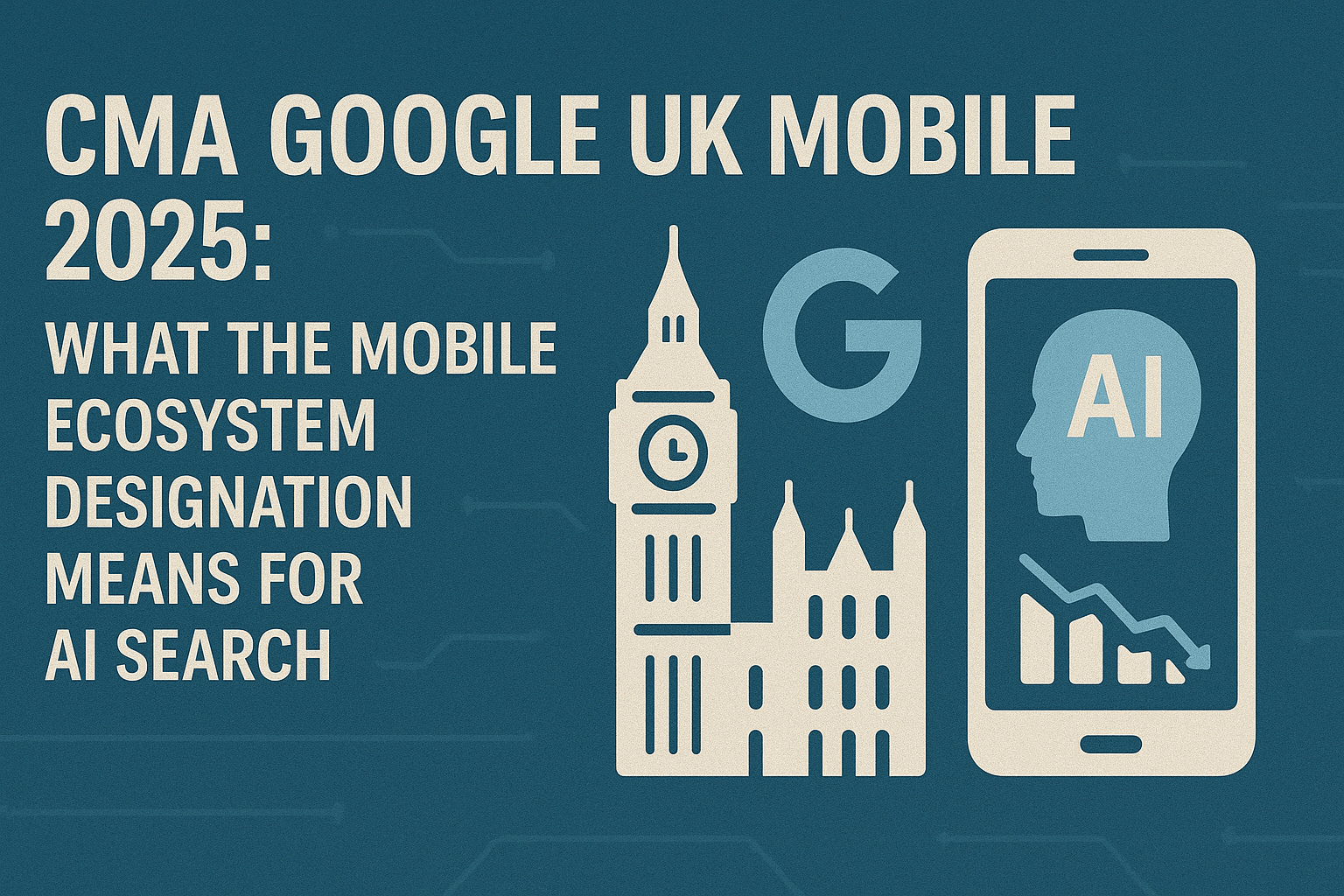
When the UK Competition and Markets Authority (CMA) officially designated Google’s Android, Chrome, and Play Store as holding “Strategic Market Status (SMS)” on 23 October 2025, the tech world reacted fast.
Google called the move “disproportionate,” while the CMA said it was “necessary to ensure fair competition and transparency in AI-driven mobile search.”
The decision marks one of the most consequential moments for digital regulation in the UK’s history. Beyond London and Westminster, the implications ripple across the £9.9 billion UK mobile app economy, affecting more than 457,000 jobs — including developers, agencies, and advertisers across Manchester’s growing digital sector.
And with Google’s Gemini AI now integrated into everything from Maps to Android search widgets, the CMA’s intervention doesn’t just regulate an app store — it reshapes how AI-powered search results will be ranked, personalized, and monetized in 2025 and beyond.
1. What the CMA’s Designation Actually Means
A. Strategic Market Status Explained
Under the Digital Markets, Competition and Consumers Act (DMCC), which came into full effect in late 2025, the CMA can label dominant tech companies as having Strategic Market Status.
The October 2025 designation applies to Google’s Android operating system, Chrome browser, and Play Store, granting regulators new powers to:
- Enforce fair access rules for app developers.
- Prevent self-preferencing in AI-driven search and recommendations.
- Mandate interoperability between rival AI assistants and browsers.
(Source: CMA.gov.uk – Mobile Ecosystem Designation, October 2025)
These obligations mean Google must seek CMA approval before changing key APIs, data-sharing protocols, or AI search defaults that could harm competition.
B. Why the CMA Targeted Mobile First
Mobile dominates UK internet usage.
Over 70% of searches now happen on smartphones, and Google commands 95% of that share, according to The Guardian’s tech economics report (Oct 2025).
The CMA concluded that this dominance — combined with AI integration into mobile experiences — risks locking users deeper into Google’s ecosystem.
That includes:
- Gemini AI appearing by default in Android’s search bar.
- Chrome Discover feeds trained on Google Ads data.
- App ranking signals in Play Store influenced by AI ad performance.
By declaring these systems part of a “strategic mobile ecosystem”, regulators can now demand algorithmic transparency, data portability, and choice screens for AI assistants.
(Source: The Guardian – CMA’s Mobile Ecosystem Ruling, Oct 2025)
C. Google’s “Disproportionate” Response
Google responded publicly within hours, calling the ruling “disproportionate and premature given ongoing global alignment on AI governance.”
The company argues that Gemini’s integration benefits users and developers by making content discovery “more relevant.”
But critics — including the CMA and multiple UK publishers — argue it also amplifies Google’s control over AI-generated summaries and search visibility.
In other words: AI convenience vs. market fairness.
And 2025 will be the year those two forces collide.
2. AI Search Overhauls: The New Landscape for 2025
A. Gemini’s Deep Integration
Google’s Gemini AI model, which replaced Bard earlier in the year, is now embedded directly into Android and Chrome.
Users can type or speak natural-language queries, and Gemini surfaces summarized answers drawn from web pages, local data, and Google’s own indexes.
This AI search layer reduces traditional organic clicks — meaning small businesses relying on SEO may see fewer visits unless they’re directly cited by Gemini.
Following the CMA’s intervention, Google must now:
- Clearly label AI-generated summaries.
- Display visible citations for UK-based content.
- Allow rival AI assistants (like OpenAI or Anthropic integrations) on Android devices.
B. Search Volume Volatility
Data from StatCounter and Moz UK shows a 45% surge in AI-related mobile queries since August 2025 — users are testing conversational search at unprecedented rates.
But click-through rates for traditional organic results fell by 22% on average across UK mobile devices.
That’s why the CMA’s designation is critical: it ensures AI results aren’t monopolized by Google’s advertising algorithms or hidden data sources.
C. Impact on UK Developers and Advertisers
The UK’s mobile development economy, worth £9.9 billion annually, depends on open access to app distribution and search visibility.
If Google’s AI-generated results favor its own ecosystem, independent developers lose reach — potentially threatening hundreds of thousands of jobs.
This is especially relevant in Manchester, where tech hubs like MediaCityUK and Circle Square host hundreds of mobile-first startups.
If AI search defaults narrow user exposure, local ad campaigns could see reduced impressions and conversions.
Our team at MCR SEO Pro has already helped Manchester agencies adjust ad tracking and keyword strategies to match Gemini’s conversational prompts.
D. Late 2025: Search Fairness Adjustments Ahead
The CMA’s ruling mandates several AI search fairness tweaks by the end of 2025:
- Choice screens for users selecting their default search or assistant app.
- Disclosure prompts when AI content summarizes publisher material.
- Opt-out controls for businesses that don’t want data used for AI training.
This could reshape how local SEO works in Manchester — particularly for companies relying on Google Maps, Ads, and reviews to reach customers.
(Source: CMA.gov.uk – Digital Markets Enforcement Powers, 2025)
3. Manchester’s Perspective: Balancing AI Search and Fair Play
A. Advertising Personalization Risks
As AI-driven recommendations become the norm, businesses risk losing control over where and how their content appears.
Gemini’s contextual personalization may show summaries without sending users to the original website — meaning fewer leads, even if visibility remains high.
Local brands depending on targeted traffic should focus on:
- Structured data (to help AI identify context correctly).
- Authoritativeness (E-E-A-T aligned pages).
- Clear source attributions for service-based content.
Our technical SEO solutions help ensure structured markup, schema validation, and citation clarity — critical now that AI summaries rely on clean metadata.
B. Manchester Developers and the £9.9B App Economy
Manchester’s growing developer workforce, part of the UK’s 457,000-strong mobile industry, faces both opportunity and challenge.
On one hand, AI tools within Gemini could accelerate coding, debugging, and app-store optimization.
On the other, stricter CMA oversight means compliance audits and data-disclosure requirements for any company using Google APIs or advertising SDKs.
For startups, the takeaway is simple:
Build transparency into your app analytics now — it’ll be mandatory later.
(Source: CMA Mobile Ecosystem Report, Oct 2025)
C. Local SEO and AI Search Intersections
AI-driven mobile search means local results are more contextual — Gemini blends reviews, citations, and past engagement.
For Manchester firms, this reinforces the importance of maintaining:
- Verified Google Business Profiles.
- Consistent local citations.
- Updated customer reviews.
Our local SEO Manchester campaigns already integrate AI-readiness auditing — ensuring structured NAP data and sentiment signals feed correctly into Gemini’s knowledge panels.
4. Compliance and Strategy: How to Stay Ahead
A. Understand CMA’s Rules for AI Fairness
The CMA’s oversight doesn’t just apply to Google; it affects any company optimizing for Android or Chrome ecosystems.
New obligations coming into force in 2026 include:
- API access audits for transparency.
- Ad disclosure labelling in AI-generated results.
- Data-sharing controls for app developers.
Businesses must prepare their sites and mobile experiences to remain visible under these stricter guidelines.
B. Optimize for AI-Driven Search Contexts
Traditional SEO alone won’t sustain visibility.
To adapt, companies should:
- Add FAQs and schema markup to answer conversational queries.
- Write context-rich content explaining products in local and national contexts.
- Include clear author and source information for trust validation.
- Create AI-friendly snippets — short, verifiable summaries Gemini can cite.
(Reference: Google Search Central – AI Overview and Citation Policy, 2025)
C. Strengthen E-E-A-T Signals
Google’s AI models increasingly weigh credibility.
Strengthen your Experience, Expertise, Authority, and Trust by:
- Publishing bylined articles from real professionals.
- Listing business credentials and case studies.
- Using HTTPS, clear privacy policies, and transparent contact information.
At MCR SEO Pro, we specialize in regulation-ready SEO for Manchester’s digital ecosystem — combining compliance, structured data, and content clarity to meet new AI and CMA standards.
D. Audit Ads and App Integrations
If your business runs Google Ads or uses Android SDKs, check whether:
- AI personalization settings comply with UK privacy law.
- You disclose user data used for ad optimization.
- Tracking tags meet CMA’s fairness and consent criteria.
Our marketing solutions include ad compliance audits aligned with CMA and ICO (Information Commissioner’s Office) recommendations.
5. Long-Term Implications for AI Search Regulation
A. A New Precedent in Digital Oversight
The CMA’s action sets a global precedent: the UK is now the first major economy to formally regulate AI integration within search ecosystems.
It extends beyond anti-trust — it’s about ensuring algorithmic fairness.
This could inspire similar frameworks from the EU’s Digital Markets Act (DMA) and even U.S. Federal Trade Commission reviews, which are watching the UK rollout closely.
B. The Push for Open AI Ecosystems
One major CMA goal is to stop “closed AI ecosystems.”
That means, in theory, you could install non-Google AI assistants or choose alternative mobile indexes by 2026.
Such pluralism might level the playing field for smaller AI startups — and SEO agencies helping clients rank in multiple ecosystems.
C. Economic Stakes for the UK
The CMA’s regulatory balancing act aims to protect innovation while keeping Google accountable.
If successful, the policy could safeguard over £9.9 billion in annual developer revenue, sustaining the UK’s global reputation as a fair, AI-forward economy.
For Manchester, that’s good news — the city’s creative and tech industries depend on visibility, fairness, and access to digital platforms that treat local players equally.
6. Practical Next Steps for Manchester Businesses
- Run a compliance audit — check data collection, tracking scripts, and app SDKs for CMA alignment.
- Refresh website metadata — include clear authorship, update frequency, and citation tags.
- Diversify visibility — invest in Bing AI, Brave Search, and emerging UK search partners to reduce dependency.
- Educate your teams — ensure your marketing staff understand new CMA disclosure rules.
- Work with regulation-ready partners — choose agencies that monitor both algorithm and legal shifts.
At MCR SEO Pro, we help businesses do all five.
Our compliance-focused SEO frameworks integrate technical optimization, structured data, and legal readiness, ensuring you stay ahead of both Google and the CMA.
Conclusion: Turning Regulation Into Opportunity
The CMA Google UK Mobile 2025 designation is more than a regulatory headline — it’s a reset button for the mobile internet.
Yes, compliance will take work.
But for UK businesses that act early, transparency and trust will become competitive advantages.
As AI search evolves, credibility and accuracy will matter more than ever.
Those who combine strong technical SEO, authentic content, and regulatory awareness will thrive in this new landscape.
Prepare for CMA changes with MCR SEO Pro’s local SEO strategies — book a free UK compliance check to safeguard your AI search visibility and keep your business future-proof for 2026.
At MCR SEO Pro, we’re helping Manchester’s innovators navigate this AI-driven regulatory shift with clarity, compliance, and confidence.