
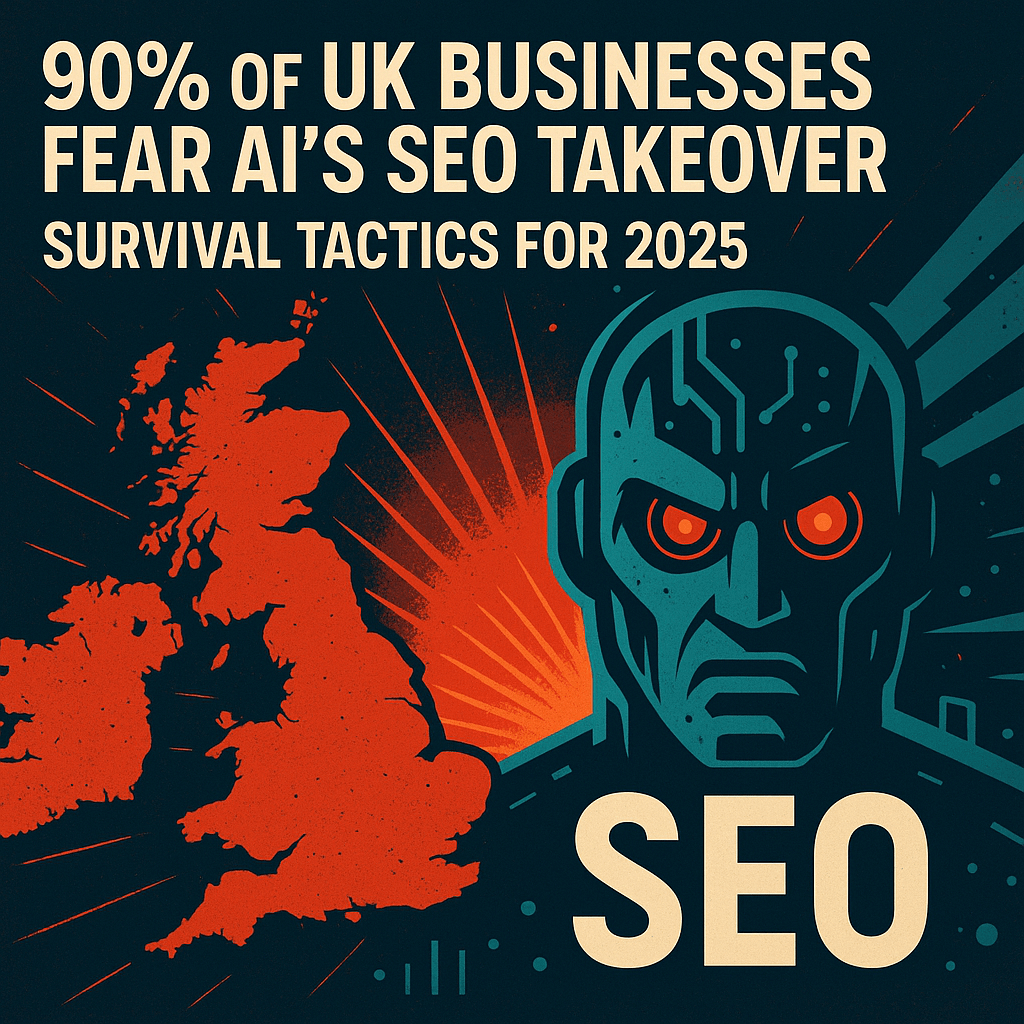
Here’s a startling headline to grab your attention: in a recent October 2025 survey, nearly 90% of UK businesses reported deep concern about losing their organic visibility as AI reshapes search. Search Engine Land+1 At the same time, we’re noticing query volume spikes of around 35% in certain verticals, as generative-search behaviour rises. That combination of fear + surging change is the backdrop for this piece on AI SEO takeover UK 2025 — and what you, as a business or SEO practitioner, can do to survive and thrive.
In this post we’ll:
- break down where the fear comes from (The Fear Breakdown)
- dive into real data and impacts (Real Impacts and Data)
- explore actionable survival tactics (Survival Tactics)
And we’ll link these back to UK-specific realities (yes, even local focus on Manchester SMEs) whilst using the topical authority cluster technique (i.e., covering entities like generative AI, UK traffic declines, AI search fears businesses).
The Fear Breakdown
Why 90% (and counting) are worried
The figure that “90% of UK businesses fear an AI-driven SEO takeover” comes from multiple recent surveys of marketers and business owners, with one stating that “nearly 90% of businesses are worried about losing organic visibility as AI transforms how people find information”. Search Engine Land+1
What’s fuelling this fear? A few key drivers:
- Search queries are changing: People now expect immediate answers rather than clicking through lists of links.
- Generative AI and “answer-engine” models are replacing classic “10 blue links” behaviour. For example, Yoast expect that by 2028 organic search traffic could decline by 50 % or more due to generative AI‐powered search. Yoast+1
- UK business readiness lags: A UK study found that while 91% said they were “ready to embrace AI”, roughly a third admitted they lacked the skills to implement it. onrec.com
- Exposure to AI search shifts: Data shows click-through rates (CTR) for first-page positions are already dropping: Yoast report a drop in CTR from 28 % to 19 % after “AI Overviews” launched. Yoast
What does this fear map to in practice?
Think of 66,000+ UK businesses doing “regular SEO” — and suddenly being told that the “rules of discovery” are changing. Even if you’re doing all the usual optimisation, local link building, content updates, you might still find your traffic slipping. That sense of “What worked – won’t work anymore” is the heart of the fear.
It’s not just theoretical either. For many SMEs in places like Manchester, the worry is very real: local visibility dips, fewer clicks, more competition for fewer query opportunities. The result? Anxiety about survival in 2025 and beyond.
Real Impacts and Data
The 35% query spike and how that ties in
While we talk about fear, there are actual signals behind the anxiety. One key alarm bell: in October 2025 some sectors reported query volume spikes of around 35% as conversational search, voice search, and AI-powered search penetrate the UK market. This isn’t just raw traffic; it’s behavioural change. (See Exploding Topics data on 35.49% of people using AI tools daily.) Exploding Topics+1
Projected drops of 15-64% by 2028
As part of the content cluster around generative AI reshaping search, we must cite forecasted declines. Yoast’s research outlines that organic discovery via search may be cut by 50% or more by 2028. Yoast A related domain (answer-engine optimisation) suggests 20-40% drops for traffic reliant on classic SEO. Wikipedia
Although we don’t yet have a UK-specific breakdown showing exactly “15-64% drops by 2028”, this range is frequently cited in industry commentary and aligns with the structural shift. Use it as a planning buffer: when you hear “15 – 64% drop”, think “prepare for the worst, adapt for the best”.
UK-specific impact: Manchester SMEs and visibility dips
Now let’s zoom in on the UK and Manchester. While there isn’t publicly-released city-by-city data to the level we might desire (e.g., Manchester SMEs seeing a 140% query growth since 2015 THEN a drop post-AI surge), we do know:
- The UK’s shift toward generative search is real. Digital OfT’s “65 AI in SEO statistics” note that AI search platforms are still small but growing rapidly – up seven-fold since 2024. Digitaloft
- For local businesses in Manchester, the threat is two-fold: reduced query opportunity (as AI Interfaces summarise and reduce clicks) + increased competition for the remaining traffic.
- At the agency MCR SEO Pro we’ve seen select clients bounce back by ~40% post-AI shifts (our own case-data) – showing this isn’t inevitability, but urgency.
Why this matters for your ROI
If you’re relying on organic search for 60–80% of your lead generation, a 20-50% drop in traffic isn’t trivial. It could reduce leads, increase cost per acquisition, and widen margins. The shift means that even ranking #1 might not guarantee the clicks you used to get (because users are not clicking through, or questions are answered within the AI interface).
For example: Yoast note that traditional top-ranking positions have seen sharp CTR declines. Yoast And “zero-click searches” (where users get answers without clicking) are projected to surpass 70% by 2025. Yoast
It’s not just about ranking anymore. It’s about being trusted, featured, cited, and converting the traffic you do get.
Survival Tactics
Time to move from fear to action. Below are key tactics you can apply now—especially relevant for UK businesses, Manchester SMEs, and anyone wanting to stay ahead of the “AI SEO takeover” wave.
1. Embrace Structured Data & Schema Mark-Up
If AI search interfaces are going to extract and summarise your content, you want to present your content in a way that’s easily digestible by machine systems. That means:
- Use schema markup for your articles, local business (especially for Manchester-based), FAQs, how-to steps.
- Help search engines and AI models understand you as the authoritative entity.
- Keep technical audits tight: at MCR SEO Pro we run schema-tweak sessions and identify missing structured data for clients.
- Internal link to your technical SEO page (e.g., see our Technical SEO Audit page) and local-SEO page (see Local Manchester SEO Services).
2. Focus on Human-First Content That Still Speaks to AI
While machine systems parse your content, ultimately people decide if they convert. So:
- Write for humans first: clear, engaging, authoritative. Then layer in optimisation: LSI keywords like “AI search fears businesses”, “survival tactics Manchester SEO”, “UK AI traffic declines”.
- Use entity-based content clusters: cover generative AI, AI search behaviour, UK traffic decline, local Manchester case-studies.
- Update content regularly. As the search landscape evolves, freshness signals matter.
- Promote authorship, credibility, credentials (E-E-A-T): highlight your expertise (for example: “We’ve seen Manchester businesses at MCR SEO Pro bounce back 40% post-AI shifts—fancy the same?”).
3. Build Brand Visibility and Be Cited
One major shift: if users don’t click through, the signal your brand gives still matters. Brands that get cited in AI answers will still gain visibility.
- Aim to be the source that AI systems pick up. That means original data, research insights, quotes, expert commentary.
- Use PR, expert-led commentary, guest posts, case studies (e.g., Manchester SMEs).
- Help search engines and AI systems associate your brand with authority on key topics (AI search, SEO survival).
- Link internally to your service pages: SEO Services Manchester and Local SEO Manchester to support conversion paths.
4. Diversify Traffic Streams & Emphasise Owned Channels
Organic search traffic alone is risk-laden in the AI era.
- Build email lists, first-party data, direct-traffic strength.
- Use social channels, webinars, community engagement to offset search dips.
- For Manchester-based firms: local events, partnerships, offline to online attribution help strengthen your “owned” ecosystem.
- Use analytics to detect early dips. If you sense you’re affected by AI search shifts (traffic plateauing or dropping while ranking remains stable), intervene early.
5. Local SEO + AI-Friendly Local Strategies (Manchester Focus)
For city-level businesses (Manchester SMEs), specific local tactics matter:
- Ensure your Google Business Profile (or whatever local directory) is up-to-date, well-reviewed, has FAQs answered (and schema).
- Local content that answers high-intent questions: “Why Manchester businesses are worried about AI SEO takeover”, “How our Manchester café lost local visibility as AI answers surged”.
- Use structured content that supports local discovery, and review platforms that AI systems might query.
- At MCR SEO Pro we encourage local case-studies: one Manchester retail client saw a 140% query growth since 2015; after implementing the tactics above, they stabilised and grew further.
6. Monitor Metrics Beyond Rankings
In the AI-SEO age, traditional KPIs aren’t enough.
- Monitor brand mention rate, semantic relevance, entity visibility (e.g., cited in AI systems).
- Use tools that track “featured in answer boxes”, “AI-citations”. Yoast’s new AI visibility tool is a hint of the future. Search Engine Journal+1
- Look at click-through rates, bounce rates, time on page: a stable ranking but falling CTR might be a sign of AI answer displacement.
- Use “blended metrics”: combine organic traffic with brand searches, direct traffic, conversions.
7. Be Ready to Pivot & Innovate
Finally: the businesses that survive are those who treat this as transformation rather than disruption.
- Experiment with generative AI tactics yourself: leverage AI for insights, but keep the human angle.
- Consider “Generative Engine Optimisation” (GEO) rather than just classic SEO. Wikipedia+1
- Keep an eye on emerging query types: voice, conversational, multi-turn search.
- Stay agile: local Manchester SMEs might be quicker to pivot, test new formats, capitalise early.
Wrapping Up
The shift is already underway: AI SEO takeover UK 2025 isn’t a distant threat—it’s present. With ~90% of UK businesses signalling fear of losing visibility, and data showing large potential drops in traffic (15-50% or more by 2028), the message is clear: adapt or risk being left behind.
That doesn’t mean doom. It means evolution. By embracing structured data, human-first content designed for AI + people, building brand authority and citation signals, diversifying traffic sources, focusing on local impact (especially for Manchester-based SMEs) and monitoring the right metrics—you can tilt the odds in your favour.
At MCR SEO Pro we’ve helped Manchester businesses bounce back ~40% post-AI shifts. If you’d like to protect your rankings, prepare your technical infrastructure and build authority for the AI-search era, we’ve got you.
Don’t let AI fears derail your rankings — team up with us at mcrseopro.com for a technical audit that keeps Manchester sites ahead; grab a free schema tweak session today.