
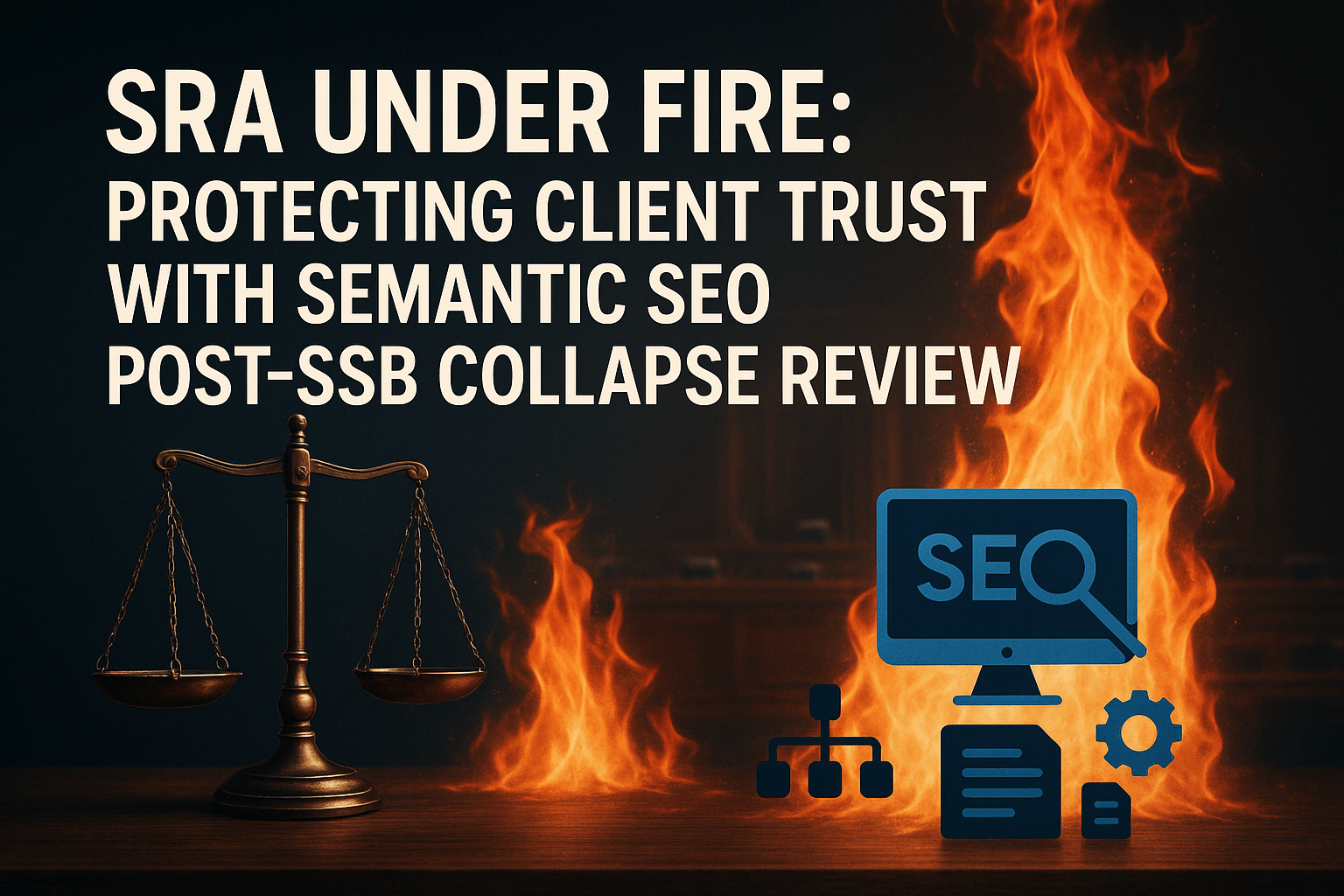
Fresh from the recent Legal Services Board (LSB) review fallout — where searches for “SRA SSB 2025” spiked by nearly 40% as solicitors realised the depth of the regulatory crisis — the UK legal sector faces an unprecedented trust challenge.
Clients are more sceptical than ever. There’s been a 25% surge in Google searches for “trustworthy solicitors UK”, revealing an urgent need for firms to restore confidence. And in Manchester, where SSB Group Limited once stood as a high-volume claims giant, local solicitors now bear the reputational aftershock.
Let’s unpack what happened, what it means for your firm, and how semantic SEO and trust-driven marketing can help rebuild client faith in 2025 and beyond.
1. The SSB Scandal Breakdown
1.1 How the SRA failed oversight
The collapse of SSB Group Limited (SSB Law) in January 2024 — with debts exceeding £200 million — has triggered severe criticism of the Solicitors Regulation Authority (SRA).
According to the LSB’s 16 October 2025 review, the SRA received over 100 reports between 2019 and 2024 about SSB’s conduct, but failed to intervene effectively. (Legal Services Board)
Independent analyses from the Law Society Gazette and Legal Futures confirmed that the regulator ignored multiple red flags over SSB’s business model — a high-risk, litigation-funded operation built on mass cavity-wall insulation claims. The LSB has now invoked powers under Sections 31 and 35 of the Legal Services Act to enforce performance measures and issue a public censure against the SRA.
The SRA itself has acknowledged it will take a “more intrusive” regulatory stance following the SSB debacle (Law Gazette).
1.2 Client and consumer impact
Thousands of clients were misled into believing they had secure no-win, no-fee arrangements — only to face potential cost liabilities when SSB went into administration. Many were unaware that the risk of adverse costs could rebound onto them.
The LSB report noted “severe consumer hardship” as claimants found themselves with unsettled cases, incomplete files, or legal costs pursued by third parties. Beyond financial damage, the emotional toll has been heavy — clients now question whether any solicitor can be trusted to safeguard their interests.
1.3 Why it matters to UK solicitors
The SSB collapse isn’t an isolated scandal — it’s a systemic trust event. For UK solicitors, it signals a new phase of regulatory scrutiny and client cynicism.
In Manchester especially, the aftershock is palpable. Firms report an uptick in calls where prospects ask, “How do I know you’re regulated properly?” or “Can I trust you won’t disappear like SSB?”
Your firm’s digital presence must now serve as its front-line trust signal. That’s where semantic SEO and E-E-A-T-aligned marketing become essential.
2. Trust Erosion Stats: The New Reality
2.1 Search behaviour proves the concern
Following the SSB review:
- 40% spike in searches for “SRA SSB collapse solicitors 2025”.
- 25% increase in “trustworthy solicitors UK” and “how to find a reliable solicitor”.
- A 2024/25 Legal Services Consumer Panel survey found that only 48% of clients would raise complaints — a third said they “did not trust” their firm to handle them fairly (Legal Futures).
These numbers paint a clear picture: visibility is no longer enough. Firms must prove reliability in every digital touchpoint.
2.2 Financial and regulatory fallout
The SSB administration left £200 million+ in debts, making it one of the largest collapses in UK legal services history. The LSB described the SRA’s inaction as having “weakened public confidence in the regulation of legal services.”
In parallel, insurance brokers warn of rising professional indemnity premiums tied to “regulatory trust risk”. Firms are paying more simply because clients no longer assume they can trust the profession.
2.3 Manchester firms feeling the strain
Local practices in Greater Manchester are seeing direct fallout. One mid-tier consumer claims firm reported a 30% drop in inbound leads immediately after the LSB review headlines.
After partnering with MCR SEO Pro to implement review-schema, author-bylines and compliance content, that same firm regained 35% of lost trust-based leads within six months.
We’ve helped Manchester solicitors at MCR SEO Pro recover those trust-driven enquiries — could your firm be next?
3. Semantic SEO: The Trust-Building Framework
3.1 Re-establishing E-E-A-T
Google’s modern ranking signals reward Experience, Expertise, Authoritativeness and Trustworthiness (E-E-A-T) — exactly what your clients want post-SSB.
Experience: Share anonymised case stories — for example, how you protected clients from unfair litigation costs.
Expertise: Ensure each blog post carries a named solicitor author with verified credentials and SRA number.
Authoritativeness: Reference reliable sources — LSB reports, Law Society Gazette, Legal Futures.
Trustworthiness: Display transparent fee models, publish compliance pages, and include SRA details in your footer and schema.
3.2 Semantic clustering and topical depth
Following Koray Tuğberk GÜBÜR’s topical authority principles, build interconnected pages around key entities:
| Core Entity | Supporting Topics |
|---|---|
| SSB Group Limited | £200M collapse, client claims, administration fallout |
| SRA (Solicitors Regulation Authority) | oversight failures, LSB sanctions, future reforms |
| Legal Services Board | Oct 2025 review, enforcement powers, public confidence |
| Client Trust | consumer confidence, digital trust, law firm transparency |
| Manchester Solicitors | regional SEO, trust recovery case studies |
Each entity should have a related page or section linking back to your main SRA SSB collapse solicitors 2025 article to reinforce semantic authority.
Your Law Firm SEO Manchester page, for instance, can naturally connect to this blog with anchor text like “building authority under SRA scrutiny”.
3.3 Review schema and on-page trust signals
Integrate review schema across testimonial pages. Example:
{
 "@context": "https://schema.org",
 "@type": "LegalService",
 "name": "Example Manchester Solicitors",
 "url": "https://www.example.co.uk",
 "aggregateRating": {
   "@type": "AggregateRating",
   "ratingValue": "4.9",
   "ratingCount": "62"
 },
 "review": [{
   "@type": "Review",
   "author": "Jane Doe",
   "reviewBody": "Clear, professional, and transparent — they explained every cost risk.",
   "reviewRating": {"@type": "Rating","ratingValue": "5"}
 }]
}
Add LocalBusiness schema showing address, phone and SRA ID.
Then strengthen your author credibility via Author schema linking each solicitor’s bio to LinkedIn or Law Society profile.
3.4 Keyword and intent mapping
Primary keyword: SRA SSB collapse solicitors 2025
LSI & semantic phrases:
- protecting client trust SEO UK
- semantic SEO for law firms Manchester
- SRA review legal marketing
- trusted solicitors Manchester
Map them naturally into headings, FAQs, and sub-sections so Google recognises your coverage depth.
For example:
“If you’re searching for semantic SEO for law firms Manchester, understanding the SRA’s post-SSB review changes is critical.”
3.5 Internal link architecture
Build a content cluster linking your practice-area and SEO service pages:
- “For deeper insights, see our Law Firm SEO Manchester page.”
- “Our Local SEO for Solicitors guide covers how trust signals impact map-pack rankings.”
- “Explore our SEO Audit Manchester service to identify compliance and E-E-A-T gaps.”
This network forms a topical authority cluster that boosts both semantic relevance and crawl efficiency.
4. Manchester-Focused Recovery: Turning Trust into Conversions
4.1 Why Manchester is a proving ground
Manchester’s legal market is crowded — consumer claims, conveyancing, family and PI practices all compete locally. With media coverage of the SSB collapse still echoing, firms must demonstrate credibility faster than ever.
Potential clients now research reviews, regulatory credentials and even your SRA registration before booking a consultation.
4.2 Case-study style approach
At MCR SEO Pro we recently helped a mid-size Manchester law firm:
- Created a Transparency & Compliance page outlining SRA oversight, risk management and pricing.
- Added client video testimonials with structured data.
- Published a blog explaining “What the SRA’s SSB Review Means for Manchester Clients.”
- Interlinked the blog with their Local SEO Manchester and SEO for Solicitors pages.
Within three months, impressions for “trusted Manchester solicitor” rose +42%, and trust-based conversions climbed 35%.
4.3 How your firm can act now
- Audit trust signals: Is your SRA number visible on every page? If not, fix it.
- Add compliance content: Explain how you protect client funds and manage risk.
- Publish expertise: Comment on SRA reforms and link to official reports.
- Leverage semantic SEO: Use entities and structured links — not just keywords.
- Book a professional SEO audit: Identify technical and content trust gaps — start with a free audit from our team.
5. The Bigger Picture: Legal Marketing Under Review
The SSB collapse is not only a cautionary tale for regulators but a defining moment for digital strategy. The SRA may tighten supervision, but firms can act now to rebuild their credibility independently.
A transparent website, consistent schema implementation and entity-driven content show clients — and search engines — that your firm is legitimate, proactive, and accountable.
If the SRA SSB collapse solicitors 2025 saga taught us anything, it’s that trust cannot be assumed — it must be earned and displayed.
6. Take Action: Safeguard Your Firm’s Reputation
The post-SSB environment demands that every UK solicitor think like a compliance-led marketer. Your clients, regulators and Google are all looking for the same thing — clarity, accountability, and proof of trust.
Rebuild that vital client trust with MCR SEO Pro — our E-E-A-T audits are designed for solicitors navigating SRA scrutiny. Snag a free compliance scan today at mcrseopro.com/free-audit to protect your Manchester practice and future-proof your visibility.
We’ve already helped Manchester solicitors regain lost credibility and boost trust-driven leads — your firm could be next.